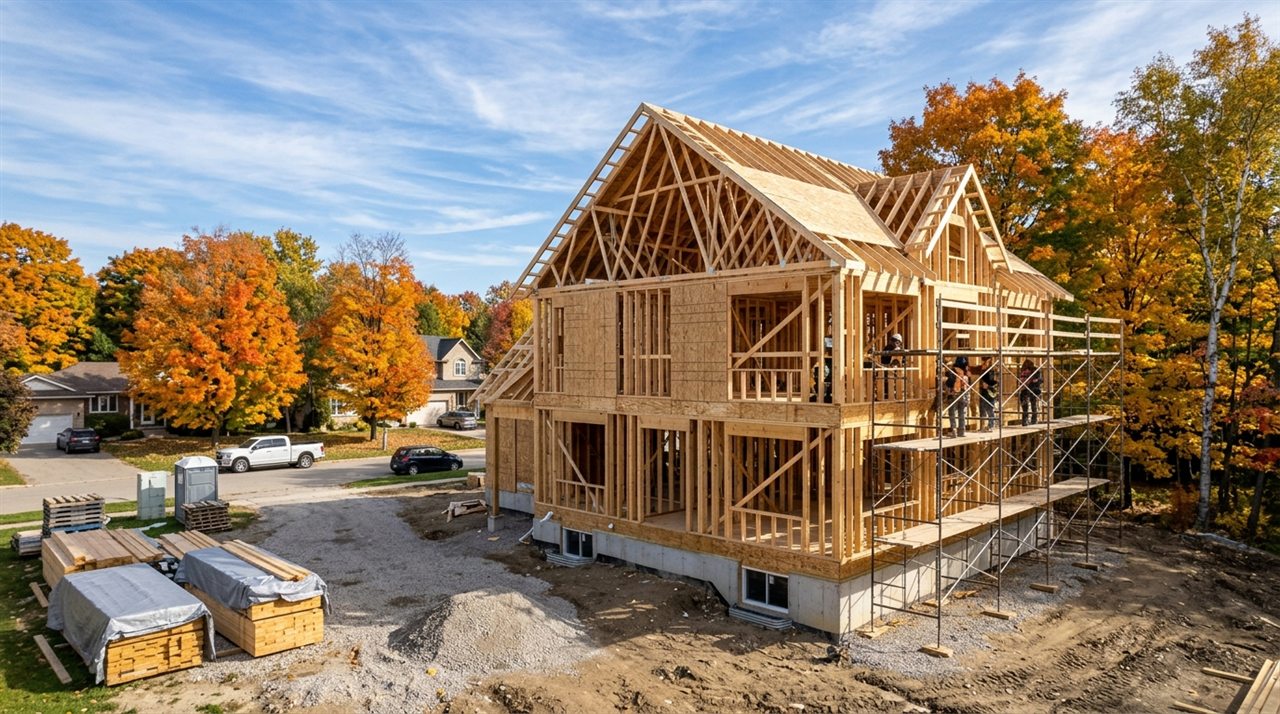
A construction draw mortgage in Ontario finances a custom home build by releasing loan funds in four to five verified stages called progress draws. Borrowers pay interest only on advanced funds while lenders withhold ten percent under Ontario's Construction Act.
Building a custom detached residence on an infill lot in Byron or Masonville (London), a family estate parcel in St. Thomas (Elgin County), or a rural acreage in Strathroy-Caradoc (Middlesex County) or Woodstock (Oxford County) requires a fundamentally different underwriting architecture than purchasing a turnkey resale property. When you buy an existing home, the collateral already stands on the land, municipal occupancy has been granted, and the lender advances 100% of the mortgage principal on closing day.
When you build from the ground up, the security is an open excavation pit and a set of architectural blueprints. To protect both the borrower and the financial institution against unfinished framing, contractor insolvency, and unremitted sub-trade invoices, Canadian chartered banks, credit unions, default insurers (CMHC, Sagen, and Canada Guaranty), and private construction lenders utilize a Progress-Advance Construction Draw Facility. Authored by Dallas Martin (Licensed Mortgage Agent Level 2, FSRA Licence #M17001133) at The Mortgage Firm (FSRA Brokerage Licence #13466), this 2026 institutional guide details the exact progress-draw mathematics, Section 22 lien holdback rules, January 2026 annual holdback-release mandates, HCRA and Tarion warranty regulations, and the $130,000 Ontario HST New Housing Rebate pathways governing custom home builds across Southwestern Ontario.
How Do Construction Draw Mortgages Work When Building a Custom Home in Ontario?
Ontario construction draw mortgages disburse capital in arrears after an accredited appraiser verifies the exact percentage of physical work completed on-site. Lenders multiply your approved construction budget by the appraiser's completion percentage, subtract prior advances, and withhold a 10% lien holdback.
The foundational underwriting rule of every Ontario construction draw mortgage is the Cost-to-Complete Principle: lenders only finance materials that are physically affixed to the land and labour that has already been performed. Soft deposits sitting in a general contractor's bank account, custom window orders sitting in a Vaughan warehouse, or architectural and municipal permit fees paid prior to excavation do not increase the physical liquidation value of the real estate security.
Before construction begins, an accredited residential appraiser (holding an AIC — Appraisal Institute of Canada designation such as CRA or AACI) reviews your stamped architectural drawings, itemised construction budget, and fixed-price builder contract alongside comparable custom sales in your immediate municipality to establish an As-Completed Appraised Value. At each subsequent draw request, the same appraiser visits the building lot to certify the Percentage Complete and the remaining Cost to Complete.
Gross Eligible Advancek = (Loanconstruction × Pctcomplete,k) − Σ Gross Advancej (for j = 1 to k − 1)Statutory Holdbackk = 0.10 × Gross Eligible AdvancekNet Cash Disbursedk = Gross Eligible Advancek − Statutory Holdbackk − Feeinspection − Feesolicitor
Because the lender only releases funds after each milestone is built and inspected, the borrower (or the HCRA-licensed builder under a turnkey contract) must possess sufficient upfront working capital to push the build from 0% to the 15%–20% Foundation Draw before the first dollar of construction mortgage principal is ever released.
What Are the Five Standard Progress Draw Milestones in Ontario?
- Advance 0 — Preliminary Land Acquisition Advance (0% Build Complete): Available on conventional bank and credit union facilities (typically advancing 65% to 75% LTV of the raw lot value at land closing) or when you already own the building lot free and clear (where 100% of your verified land equity counts toward your required project down payment). Critical Regulatory Exception: Under CMHC Improvement high-ratio default-insured construction loans (up to 95% LTV), loan advances on vacant land are strictly prohibited—the borrower must hold registered title to the lot prior to the first draw, or execute a single turnkey Agreement of Purchase and Sale (APS) with an HCRA-licensed builder covering both land and home.
- Draw 1 — Excavation, Footings & Poured Foundation (15% to 20% Complete): Triggered once the lot is excavated, concrete footings and foundation walls are poured and cured, weeping tile and exterior damp-proofing membrane are installed, and the foundation is backfilled with a municipal foundation inspection pass. The AIC appraiser conducts the first site inspection ($250 to $450) and your real estate lawyer runs a Teranet title subsearch ($200 to $350) to confirm zero liens before releasing the net advance.
- Draw 2 — Structural Framing & Weather-Tight Lock-Up (40% to 50% Complete): Released when structural floor joists, exterior walls, engineered roof trusses, roof sheathing, and shingles are installed, and all exterior windows and exterior doors are physically mounted so the structure can be locked and protected from snow and rain.
- Draw 3 — Mechanical Rough-Ins, Insulation & Taped Drywall (70% to 85% Complete): Disbursed after rough plumbing, HVAC ductwork, and electrical wiring are installed and approved by the municipal building inspector and the Electrical Safety Authority (ESA), insulation and vapour barriers are sealed, drywall is hung and taped, and primary kitchen cabinetry and bathroom fixtures are on-site or roughed in.
- Draw 4 — Substantial Completion & Municipal Occupancy Permit (97% to 100% Complete): Triggered when interior trim, flooring, painting, mechanical trim-outs, grading, and final municipal safety inspections are complete and the municipality issues a formal Occupancy Permit. If a build reaches completion between November and March in London, Middlesex, Elgin, or Oxford counties—when frozen ground prevents final topsoil grading, sodding, or asphalt driveway paving—lenders establish a specific Seasonal Holdback (typically $5,000 to $25,000, or 100% to 150% of the unfinished exterior work) held in trust until spring completion so the rest of the mortgage can convert to its permanent amortizing take-out term on schedule.
The key point is that construction draw mortgages operate strictly on verified physical progress in arrears: you cannot use Draw 1 mortgage proceeds to pay upfront builder deposits before concrete is in the ground, and every draw is reduced by the mandatory 10% statutory lien holdback plus roughly $450 to $800 in combined appraiser inspection and legal title subsearch disbursements.
How Do CMHC Insured Progress Draws Compare to Conventional Bank and Private Construction Loans?
CMHC Improvement insured construction mortgages allow as little as 5% to 10% down up to $1.5 million across four progress draws but prohibit vacant land advances. Conventional bank draws cap loan-to-value at 80% and require fixed-price builder contracts plus 15% contingencies.
In Ontario's residential lending market, custom home construction financing is divided into three distinct underwriting channels: High-Ratio Default-Insured Progress Draws (CMHC Improvement, Sagen, and Canada Guaranty), Conventional Chartered Bank & Credit Union Progress Draws, and Alternative B-Lender / Private MIC Construction Facilities. Selecting the wrong channel—or signing a cost-plus builder contract before speaking with an underwriter—can stall a custom build mid-framing.
1. CMHC Improvement & CMHC Home Start Insured Progress Draws (Up to 95% Tiered LTV)
For owner-occupied 1-to-2 unit custom builds where the total as-completed lending value (land plus hard construction costs) is under $1,500,000, default insurers allow qualified borrowers with a minimum 600 Equifax credit score to build with a high-ratio tiered down payment:
- 5.00% minimum down payment on the first $500,000 of total lending value ($25,000); plus
- 10.00% minimum down payment on the portion between $500,000 and $1,499,999.99 (for example, on a $950,000 custom build in St. Thomas or Strathroy, the minimum statutory down payment is $25,000 + $45,000 = $70,000, or 7.37% combined equity).
- Strict Prohibition on Vacant Land Advances: Under official CMHC Improvement underwriting guidelines, loan advances on vacant land are not permitted. Even though the insurer calculates your maximum loan against the combined land-plus-build value across up to four progress advances, the borrower must hold registered title to the building lot prior to the first advance (or contract under a single turnkey builder APS where the builder finances the lot).
- Post-December 15, 2024 30-Year Insured Amortization Rule: Under federal mortgage rules effective December 15, 2024, both first-time home buyers AND repeat home buyers purchasing or constructing a newly built home qualify for a 30-year insured amortization up to the $1,499,999 cap under CMHC Home Start, Sagen, and Canada Guaranty new-build guidelines. Choosing a 30-year amortization adds a mandatory +0.20% insurance premium surcharge (raising the standard 4.00% premium at 90.01%–95.00% LTV to 4.20%, capitalized into the loan principal), while the 8.00% Ontario Retail Sales Tax (RST) on the insurance premium must be paid in cash at closing.
2. Conventional Chartered Bank & Credit Union Progress Draws (Up to 80% LTV)
When a custom build in London, Grand Bend, or Woodstock exceeds the $1,500,000 insured ceiling—or when the borrower prefers to avoid default insurance premiums by contributing at least 20% equity—financing moves to a conventional institutional progress-draw facility (offered by Schedule I banks such as RBC, Scotiabank, CIBC, and National Bank, as well as regional Ontario credit unions such as Meridian, Libro, and FirstOntario):
- Maximum 80% Loan-to-Value (LTV) of the lesser of total project cost or the AIC appraiser's as-completed market value. In practice, because land release ratios are capped at 65% to 75% LTV and banks hold back 10% on every draw, borrowers typically require 20% to 35% total project equity (combining free-and-clear land equity plus liquid cash).
- Mandatory Fixed-Price Turnkey Contract vs. Cost-Plus Rejection: Virtually all Canadian Schedule I chartered banks require a signed, stipulated fixed-price construction contract with a licensed builder registered with the Home Construction Regulatory Authority (HCRA) and enrolled with Tarion. Standard retail banks routinely reject cost-plus contracts (where the homeowner pays raw material/sub-trade invoices plus a 12%–20% builder management fee) because cost overruns fall 100% on the borrower.
- Verified 10% to 15% Liquid Contingency Reserve: Institutional underwriters require proof of unencumbered liquid savings (TFSA, high-interest savings, or unused HELOC capacity on an existing residence) equal to 10% to 15% of the hard construction budget ($50,000 to $75,000 on a $500,000 build) to absorb material price spikes and fund the gap between contractor deposits and Draw 1.
3. Alternative B-Lender & Private / MIC Construction Facilities (75%–80% LTC / 65%–75% LTV)
For experienced self-builders acting as their own general contractor, buyers executing a cost-plus architectural build, rural estate parcels on private well and septic systems, or incorporated business owners utilizing self-employed stated-income underwriting (which mandates a strict minimum 20% down payment / maximum 80% LTV), Mortgage Investment Corporations (MICs) and private construction lenders structure flexible draw schedules based on 75% to 80% Loan-to-Cost (LTC) (capped at 65% to 75% of as-completed value). Once the municipal Occupancy Permit is issued, we refinance the completed home out of the private construction loan into a prime wholesale take-out mortgage at 4.64% conventional fixed or 3.50% variable.
| Underwriting Parameter | CMHC Improvement Insured Draw | Conventional Bank / Credit Union Draw | Private / MIC Custom Construction |
|---|---|---|---|
| Maximum Loan-to-Value (LTV) | Up to 95.00% tiered LTV (5% on first $500k; 10% up to $1,499,999) | Up to 80.00% LTV of lesser of cost or as-completed appraised value | 65.00% to 75.00% LTV (up to 75%–80% Loan-to-Cost on hard budget) |
| As-Completed Value Cap | Strictly under $1,500,000 (1–2 unit owner-occupied) | No statutory price cap (sliding scale LTV above $2.0M) | No statutory price cap ($500,000 to $5,000,000+ custom estates) |
| Vacant Land Advance Rule | 0% Advance on Vacant Land (must own lot title by Draw 1 or use single builder APS) | Up to 65%–75% LTV advance at land closing; 100% of owned land equity credited | Up to 50%–65% LTV on raw or serviced land; custom draw tranches |
| Builder Contract & Self-Build Rules | HCRA-licensed & Tarion-enrolled builder required by most prime lenders | Fixed-price HCRA contract required by Big 6 banks (select credit unions allow owner-built) | Accepts Owner-Built (Self-Build), Cost-Plus, and General Contractor models |
| Construction-Phase Interest Rate | Prime (4.45%) to Prime + 1.00% (5.45%) interest-only on drawn balance | Prime (4.45%) to Prime + 1.50% (5.95%) interest-only on drawn balance | 8.99% to 12.99% interest-only on drawn funds (+ 1.50%–3.00% facility fee) |
| Take-Out Amortization & Rate | Up to 30 Years (CMHC Home Start +0.20% surcharge) at 4.49% 5-Yr Fixed / 3.50% Var | Up to 25–30 Years Conventional at 4.64% 5-Yr Fixed or 3.50% Variable | Refinanced into Prime 4.64% Fixed or 3.50% Variable upon Occupancy Permit |
The takeaway is that while CMHC Improvement unlocks 90% to 95% LTV financing under $1.5 million, you must already hold title to the building lot before Draw 1 is released unless you purchase land and construction together under a single turnkey builder contract.
How Does the 10% Statutory Construction Lien Holdback Work Under Section 22 of Ontario's Construction Act?
Under Section 22 of Ontario's Construction Act, mortgage lenders and property owners must withhold 10% of every progress advance as a statutory lien holdback. These funds are released 60 calendar days after substantial completion if no sub-trade liens are registered.
The single most misunderstood mechanism in Ontario custom home financing is the 10% Statutory Lien Holdback mandated by Section 22 of Ontario's Construction Act (R.S.O. 1990, c. C.30). Many homeowners mistakenly believe the bank withholds 10% because it distrusts their personal credit profile. In reality, the lender is complying with provincial construction lien legislation designed to protect sub-trades—the excavation crew, concrete forming company, framing carpenters, roofers, plumbers, and electricians—who supply materials and labour to your property without having a direct contract with you or your bank.
Under Ontario law, every person who supplies services or materials to an "improvement" on land acquires a statutory right to register a Construction Lien directly against your property's Teranet parcel register if the general contractor fails to pay them. Crucially, under Section 78 of the Construction Act, a mortgage lender that advances progress draws without retaining the mandatory 10% basic holdback—or that advances funds in the face of an existing registered lien—loses its first-priority security over those deficiency amounts.
The 60-Day Lien Preservation Window & Running Holdback Ledger
Under Ontario's modernized Construction Act (which extended the legacy pre-reform 45-day deadline to a strict 60-calendar-day lien preservation period), the statutory holdback operates through a disciplined legal sequence:
- Mandatory 10% Deduction on Every Tranche: When the appraiser certifies that your $500,000 construction facility has reached 20% completion ($100,000 gross eligible advance) at Draw 1, the lender's solicitor deducts $10,000 (10%) into a Running Holdback Ledger and disburses $90,000 (less inspection and legal subsearch fees). Across all four draws totaling $500,000, the lender retains $50,000 in cumulative statutory holdback.
- Teranet Title Subsearch Prior to Every Advance: Before wiring a single dollar at Draw 1, Draw 2, Draw 3, or Draw 4, the lender's real estate lawyer conducts a live Teranet Land Titles subsearch. As documented in Ontario construction litigation practice (including a notable King City custom rebuild draw-freeze analysed by Ontario construction counsel at Treadstone Law), if a single unpaid framing or concrete sub-trade registers a $28,000 claim for lien on title, the bank immediately freezes 100% of all future construction draws until the lien is discharged or vacated by posting cash or a lien bond into court (plus up to 25% for legal costs, capped at $250,000).
- Substantial Performance & the 60-Day Clock: Once the custom home is ready for occupancy and the remaining work or defects represent less than 3% of the contract price (or upon publication of a Certificate of Substantial Performance in a daily construction trade newspaper), the 60-calendar-day lien preservation clock begins ticking.
- Day 61 Holdback Release: On Day 61 after substantial performance (or total completion), provided your solicitor's final Teranet subsearch confirms zero registered construction liens on the parcel register, the lender releases the entire 10% accumulated holdback ($50,000) so you can settle final holdback invoices with your builder.
January 2026 Mandatory Annual Holdback Release Rules for Multi-Year Builds
Custom home buyers in Southwestern Ontario must also account for the January 2026 mandatory annual holdback release regime enacted through recent amendments to Ontario's Construction Act. While actual physical framing and finishing typically span 8 to 14 months, an end-to-end luxury custom build or complex rural estate in London, Grand Bend, or Middlesex County frequently spans 18 to 30 months (3 to 6 months for architectural engineering, 2 weeks to 4+ months for municipal site-plan and conservation authority approvals, and 12 to 18 months for construction).
Under the 2026 annual holdback regime, construction contracts exceeding 12 months are subject to mandatory annual release of accrued statutory holdbacks on the contract's anniversary date (provided no liens are preserved on title and statutory notice conditions are met), eliminating the historical threshold restrictions that previously locked sub-trade holdbacks for two years or more. Your construction mortgage commitment and builder contract must be synchronized with these 2026 annual holdback release milestones so lender disbursements match your contractor's statutory payment rights.
In summary, Ontario's Construction Act requires a strict 10% statutory holdback on every progress draw, enforces a 60-day lien expiry window after substantial completion, and mandates annual holdback releases on multi-year builds under the January 2026 regulatory framework.
How Is Monthly Construction Interest Calculated and How Does Take-Out Conversion Work at Occupancy?
During active construction in Ontario, borrowers make interest-only monthly payments calculated strictly on the cumulative principal drawn to date, not the total approved loan. Once an occupancy permit is issued, the loan converts into a standard amortizing take-out mortgage.
One of the major cash-flow advantages of an institutional construction draw mortgage is that you do not pay interest on unadvanced funds sitting in the bank's facility commitment. During the 8-to-14 month construction phase, your loan operates as an open, floating-rate interest-only facility priced against the Canadian Prime Rate (currently 4.45% as of October 2026, anchored by the 2.25% Bank of Canada overnight target rate) plus an institutional construction spread of 0.00% to +1.50% (yielding an effective construction rate of 4.45% to 5.95%).
Interestmonthly,k = Bdrawn,k × ((Rprime + Spreadconstruction) ÷ 12)im (Take-Out Effective Monthly Rate) = (1 + (Rtakeout ÷ 2))(1 ÷ 6) − 1At Rtakeout = 4.64% Conventional Fixed: im = (1.0232)0.16667 − 1 ≈ 0.0038295 (0.38295% per month)
Case Study: $500,000 Construction Draw Facility on an $800,000 Custom Home in London or St. Thomas
Consider a family in London or St. Thomas who owns a serviced building lot valued at $225,000 free and clear, contributes $75,000 in liquid cash (for $300,000 total equity, or 37.5% of the $800,000 completed project), and secures a $500,000 Conventional Construction Draw Facility (62.5% LTV). The table below models exact gross draws, 10% Section 22 statutory holdbacks, net cash released, and monthly interest-only carrying costs at both Prime (4.45%) and Prime + 0.50% (4.95%) across a 10-month build, followed by permanent take-out conversion:
| Build Stage & Verified % Complete | Gross Draw Eligible | 10% Statutory Holdback (s. 22) | Net Cash Disbursed (Cumulative) | Cumulative Drawn Balance | Monthly Interest @ 4.45% Prime | Monthly Interest @ 4.95% (P+0.50%) |
|---|---|---|---|---|---|---|
| Stage 0: Lot Owned Free & Clear (0%) | $0 | $0 | $0 ($0) | $0 | $0.00 / mo | $0.00 / mo |
| Draw 1: Poured Foundation & Backfill (20%) | $100,000 | −$10,000 | $90,000 ($90,000) | $100,000 | $370.83 / mo | $412.50 / mo |
| Draw 2: Framing, Roof & Lock-Up (50%) | $150,000 | −$15,000 | $135,000 ($225,000) | $250,000 | $927.08 / mo | $1,031.25 / mo |
| Draw 3: MEP Rough-Ins & Drywall (80%) | $150,000 | −$15,000 | $135,000 ($360,000) | $400,000 | $1,483.33 / mo | $1,650.00 / mo |
| Draw 4: Occupancy Completion (100%) | $100,000 | −$10,000 | $90,000 ($450,000) | $500,000 | $1,854.17 / mo | $2,062.50 / mo |
| Day 61 Lien Expiry & Take-Out Term Conversion | Holdback Released | +$50,000 Released | $500,000 (100% Disbursed) | $500,000 | Converts to 25-Yr Take-Out @ 4.64% Fixed ($2,806.45/mo P&I) or 3.50% Variable ($2,496.35/mo P&I) | |
Once the final inspection is cleared and the 60-day statutory lien holdback is disbursed, your temporary construction facility converts into a permanent Take-Out Mortgage (with Wholesale Rates as of October 2026 starting at 4.39% 3-Year Fixed Insured, 4.49% 5-Year Fixed Insured, 4.64% 5-Year Fixed Conventional, and 3.50% 5-Year Variable [Prime − 0.95%]). When structuring your take-out conversion, we intentionally prioritize lenders that register a Standard Charge Mortgage rather than a restrictive Big-Bank Collateral Charge so your completed home retains full $0 straight-switch mobility at future renewals. You can also lock your permanent take-out rate up to 120 days prior to completion via the NewLife Rate Watcher and compare fixed versus variable trajectories in our 2026 Ontario Mortgage Rate Forecast.
The key point is that during active construction you only pay interest on the cumulative capital drawn at each completed milestone—starting at just $370.83 to $412.50 per month at the foundation stage on a $500,000 facility—before converting into a full principal-and-interest mortgage of $2,806.45 per month (at 4.64% over 25 years) upon final completion.
What Are the HCRA Licensing and Tarion Warranty Rules for Contract Builds vs. Owner-Built Homes in 2026?
In Ontario, hiring an HCRA-licensed builder provides up to $400,000 in Tarion structural warranty coverage and $40,000 in contract financial loss protection. Owner-built homes carry zero Tarion warranty coverage and require a mandatory Tarion Letter of Confirmation before permit issuance.
Under the New Home Construction Licensing Act, 2017 and the Ontario New Home Warranties Plan Act, both municipal building departments and institutional mortgage underwriters classify every custom residential build in Ontario into one of two legal categories: a Contract Home Build or an Owner-Built Home (Self-Build).
1. Contract Home Builds (HCRA-Licensed Builder & Tarion Enrolment)
When you contract with a builder licensed by the Home Construction Regulatory Authority (HCRA) (verifiable on the official Ontario Builder Directory) to construct a custom home on land you own (or purchase land and home together from a licensed vendor), the home must be enrolled with Tarion prior to municipal building permit issuance. This structure unlocks two critical layers of statutory protection that prime banks require:
- Up to $400,000 in Statutory Tarion Warranty Coverage: Includes the 1-Year Warranty (defects in workmanship and materials, Ontario Building Code violations, and fitness for habitation), the 2-Year Warranty (water penetration through the basement or foundation, building envelope water ingress, and electrical, plumbing, and heating delivery distribution systems), and the 7-Year Major Structural Defect (MSD) Warranty covering load-bearing failure up to a combined statutory cap of $400,000.
- Delayed Occupancy, Relocation & Contract Financial Loss Protection: Provides up to $150 per day (up to $15,000 maximum) for temporary accommodation and relocation if a licensed builder fails to deliver occupancy on schedule, plus up to $40,000 in financial loss coverage under a Landowner's Construction Contract if a licensed builder defaults prior to completion.
- Mandatory April 1, 2026 Tarion 45-Day Deposit Notification Rule: Effective April 1, 2026, Ontario buyers purchasing a new freehold custom home must formally register and notify Tarion of their purchase agreement within 45 calendar days of signing to qualify for the maximum statutory deposit protection ceiling (whereas late notifications risk reduced deposit recovery limits in the event of builder insolvency or illegal building).
2. Owner-Built Homes / Self-Builds (Substantive Control Test & Tarion Letter of Confirmation)
An Owner-Built Home occurs when a landowner acts as their own general contractor—directly hiring, scheduling, and paying individual sub-trades (excavation, concrete, framing, HVAC, electrical) to build a home for their own personal occupancy. Under HCRA enforcement guidelines, substance overrides contract labels: if an unlicensed contractor calls themselves a "project manager" or "construction consultant" while exercising substantive control over essential building elements, they are operating as an illegal unlicensed builder.
- Zero Tarion Warranty or Deposit Coverage: Legitimate owner-built homes are exempt from HCRA licensing and Tarion enrolment, meaning the homeowner receives $0 in Tarion deposit protection and $0 in 1/2/7-year structural warranty coverage while assuming full legal liability under Ontario's Occupational Health and Safety Act as the project "constructor."
- Mandatory Tarion Letter of Confirmation: Before a municipality in London, St. Thomas, Strathroy-Caradoc, or Woodstock will issue a building permit for an owner-built custom home, the landowner must apply to Tarion and obtain an official Letter of Confirmation attesting that the residence is a bona fide owner-built home for personal occupancy and not a speculative build for immediate resale.
- Heightened Lender Equity & Contingency Thresholds: Because there is no HCRA builder bond or Tarion backstop, most Big Six banks decline pure self-builds; financing is placed through specialized Ontario credit unions, Alt-A construction desks, or private/MIC facilities requiring 25% to 35%+ borrower equity, verified trade quotes, and a 10% to 15% liquid cash contingency.
The takeaway is that hiring an HCRA-licensed, Tarion-enrolled builder unlocks 80% to 95% LTV prime institutional draw mortgages and up to $400,000 in statutory warranty protection—provided you register your contract under Tarion's April 1, 2026 45-day notification rule—whereas self-builds carry zero Tarion coverage and require higher borrower equity.
How Does the 2026 Expanded $130,000 Ontario HST New Housing Rebate Work for Custom Home Builds?
Under Ontario's expanded 2026 HST New Housing Rebate, qualifying custom home builders can recover up to $130,000 in combined federal and provincial tax. However, owner-built homes on borrower land must physically break ground by March 31, 2027, and claim post-completion.
Every custom home constructed in Ontario is subject to 13% Harmonized Sales Tax (5% Federal GST + 8% Ontario Provincial HST) on hard construction labour, materials, and builder contracts. As detailed in our 2026 Ontario $130,000 HST New Home Rebate Master Guide, custom home borrowers must distinguish carefully between the Standard Year-Round Baseline GST/HST New Housing Rebate and the 2026 Enhanced $130,000 First-Time & Custom Home Rebate Window (April 1, 2026 – March 31, 2027)—and crucially, between Path 1 (Turnkey Builder APS) and Path 2 (Owner-Built Custom Home on Borrower-Owned Land).
1. Standard Year-Round Baseline GST/HST Rebate (Up to $24,000–$30,300)
Outside the enhanced 2026 eligibility rules (or for repeat buyers who do not meet the enhanced criteria), the permanent baseline rebate under Section 256 of the federal Excise Tax Act provides:
- Federal 5% GST Portion (36% Rebate up to $6,300): Available only when the Completed Fair Market Value (FMV of land plus completed house) is $350,000 or less. Between $350,000 and $450,000, the federal rebate phases out linearly via
RebateFed = $6,300 × (($450,000 − FMV) ÷ $100,000), dropping to $0 at $450,000+ (which eliminates the baseline federal rebate on virtually all modern Southwestern Ontario custom builds). - Ontario 8% Provincial Portion (75% Rebate up to $24,000 Maximum): Reimburses 75% of the 8% provincial tax paid on construction up to a hard statutory cap of $24,000 (reached once eligible construction expenses hit $400,000), with no upper fair-market-value clawback provided the home is built as a primary residence.
2. 2026 Enhanced $130,000 HST Rebate: Path 1 (Builder APS) vs. Path 2 (Owner-Built Draw Mortgage)
Under the harmonized 2026 federal and Ontario provincial rebate expansion (providing up to $50,000 Federal GST relief + $80,000 Ontario HST relief = $130,000 combined on homes valued up to $1,500,000 during the April 1, 2026 to March 31, 2027 Ontario window, with a linear phase-down from $130,000 to $24,000 between $1,500,000 and $1,850,000), the statutory trigger dates and cash-flow mechanics differ dramatically depending on who owns the land during construction:
| Rebate Rule & Cash-Flow Dimension | Standard Year-Round Baseline Rebate | 2026 Enhanced Path 1: Turnkey Builder Land + Home APS | 2026 Enhanced Path 2: Owner-Built on Borrower Land (Draw Mortgage) |
|---|---|---|---|
| Maximum Combined Tax Rebate | $24,000 on builds ≥$450,000 (up to $30,300 if FMV ≤$350,000) | Up to $130,000 ($50k Federal + $80k Ontario up to $1.5M) | Up to $130,000 ($50k Federal + $80k Ontario up to $1.5M) |
| Phase-Out Valuation Threshold | Federal $0 at $450,000+; Ontario $24,000 flat uncapped | Full $130k up to $1,500,000; phases down to $24k at $1,850,000 | Full $130k up to $1,500,000 FMV; phases down to $24k at $1,850,000 |
| Statutory Eligibility Trigger Deadline | Permanent year-round statutory provision | APS signed between April 1, 2026 & March 31, 2027 (start by Dec 31, 2028) | Must physically break ground (excavation/footings) between April 1, 2026 & March 31, 2027 |
| Substantial Completion Deadline | File within 2 years of occupancy / substantial completion | Ownership transferred by December 31, 2031 | Must reach 90%+ substantial completion by December 31, 2029 |
| How & When Rebate Cash Is Received | Post-completion CRA refund via Forms GST191 & RC7191-ON | Assignable to builder as an upfront Statement of Adjustments credit at closing | No upfront closing credit: borrower funds 13% HST during draws & files GST191 + GST191-WS + RC7191-ON post-completion |
This distinction between Path 1 and Path 2 is critical for construction draw mortgage underwriting. When you build on your own lot using a progress-draw mortgage (Path 2), you cannot assign the $130,000 HST rebate to your builder as an upfront closing credit. Instead, your construction draw budget must carry the full 13% HST across every trade invoice and progress advance. Once the home reaches 90%+ substantial completion (or occupancy), you submit CRA Form GST191 (New Housing Rebate Application for Owner-Built Houses), Form GST191-WS (Construction Summary Worksheet) itemizing every HST-registered contractor invoice, and Form RC7191-ON (Ontario Rebate Schedule) within 2 years to receive your direct CRA rebate deposit—which can then be applied as a lump-sum principal prepayment against your take-out mortgage.
In summary, owner-built custom homes financed via construction draw mortgages can claim up to $130,000 under the 2026 Ontario HST Rebate expansion, but construction must physically commence on-site between April 1, 2026 and March 31, 2027 (with substantial completion by December 31, 2029), and the borrower must finance the 13% HST during the build before claiming the refund post-completion via CRA Forms GST191 and RC7191-ON.
What Does It Cost Per Square Foot to Build a Custom Home in London, St. Thomas, Woodstock, and Strathroy in 2026?
In 2026, building a custom detached home in Southwestern Ontario costs $400 to $500 per square foot for standard custom finishes and $500 to $600+ for architectural builds, excluding land acquisition and $30,000 to $80,000 in municipal development charges.
Before an institutional underwriter in London or St. Thomas will approve a construction draw commitment, your line-item construction budget must pass an Appraiser Cost-to-Complete Stress Audit. If a borrower submits an artificially low budget of $220 per square foot on a 2,200-square-foot home, the AIC appraiser and bank underwriter will flag a construction cost shortfall and require the borrower to inject the difference in cash upfront before Draw 1 is authorized.
2026 Southwestern Ontario Hard & Soft Construction Cost Benchmarks
- Hard Construction Costs ($400 to $600+ per sq. ft.): Across Middlesex, Elgin, and Oxford counties in 2026, standard custom construction averages $400 to $500 per square foot (putting a 2,000 sq. ft. two-storey or bungalow hard build at $800,000 to $1,000,000 before land), while upgraded architectural custom homes with stone masonry, custom millwork, and walkout lower levels range from $500 to $600+ per square foot ($1,000,000 to $1,200,000). Upgrading to a Net-Zero Energy Ready building envelope adds roughly 5% to 10% ($25 to $95/sq. ft.) in upfront capital while reducing annual heating and cooling utility outlays by $1,500 to $3,000 per year (and qualifying for a 25% CMHC Eco Plus insurance premium refund on insured builds).
- Municipal Building Permits & Development Charges ($30,000 to $80,000): Municipal building permit fees across Southwestern Ontario average $1.50 to $2.50 per square foot. More significantly, municipal Development Charges (DCs) on a new single-family detached lot in London, St. Thomas, Woodstock, and Strathroy-Caradoc range from $30,000 to $80,000—a substantial soft cost that must be paid at permit issuance, though still a fraction of Ottawa ($90,000 to $150,000) or the Greater Toronto Area (where municipal DCs average $180,600 per single-family lot). (Note: If you are adding a backyard garden suite or secondary unit to an existing lot rather than building a primary custom home on a new parcel, up to 3 units are exempt from municipal Development Charges under Ontario's Bill 23—see our London & St. Thomas ARU and Garden Suite Financing Guide.)
- BCIN Architectural Design vs. P.Eng Structural & Part 8 Rural Septic Engineering: Under Ontario's Architects Act, single-family residential homes meeting Part 9 size thresholds do not require a full licensed architect (whose fees average 8% to 15% of build cost or $150 to $250/hr); borrowers can utilize a qualified designer holding a provincial BCIN (Building Code Identification Number) paired with a licensed Professional Engineer (P.Eng) stamp for point-loaded steel beams, wide open-concept truss spans, walkout retaining foundations, and rural Part 8 Ontario Building Code Class 4 septic systems and drilled potable wells (which add $35,000 to $65,000 on unserviced rural lots in Strathroy-Caradoc, Central Elgin, and Thames Centre).
| Southwestern Ontario Municipality | 2026 LSTAR Resale Benchmark (Min High-Ratio Down) | Typical Serviced Infill / Estate Lot Cost | 2,000 Sq. Ft. Custom Build Hard Cost ($400–$500/sf) | Municipal Development Charges & Permit Window |
|---|---|---|---|---|
| London (Detached / Composite) | $662,000 Detached ($41,200 down) / $557,000 Composite ($30,700 down) | $225,000 – $375,000+ (Byron, Sunningdale, Kilworth) | $800,000 – $1,000,000 | $45,000 – $80,000 DCs; 3–8 wks permit review (+ UTRCA if regulated) |
| St. Thomas & Central Elgin | $584,000 Benchmark ($33,400 min down) | $175,000 – $265,000 (Talbotville, Port Stanley corridor) | $800,000 – $975,000 | $32,000 – $55,000 DCs; 2–6 wks municipal permit turnaround |
| Woodstock & Oxford County | $658,000 Benchmark ($40,800 min down) | $190,000 – $290,000 (North Woodstock, Ingersoll, Tavistock) | $800,000 – $985,000 | $35,000 – $62,000 combined City & Oxford County DCs |
| Strathroy-Caradoc & Middlesex | $625,000 Benchmark ($37,500 min down) | $180,000 – $285,000 (Mount Brydges, Komoka, Ilderton) | $800,000 – $1,000,000 (+ $45k Part 8 septic/well if rural) | $30,000 – $58,000 DCs; 2–8 wks (longer if LTVCA/ABCA watershed) |
If you are an existing homeowner in London or St. Thomas who wants to begin foundation excavation on a custom lot before selling your current residence—or without breaking an existing ultra-low fixed mortgage mid-term—explore our Short-Term Second Mortgage & Blended Rate Math Guide to see how a temporary equity facility on your current home can fund your building lot and Draw 1 working capital. First-time custom builders should also pair their construction down payment with the tax-free pools detailed in our First-Time Home Buyer Hub and FHSA + RRSP HBP Down Payment Stacking Master Guide.
The key point is that realistic 2026 custom construction budgets in London, St. Thomas, Woodstock, and Strathroy require $400 to $500+ per square foot in hard building costs plus $30,000 to $80,000 in municipal development charges, making upfront equity structuring and contingency planning essential before excavation begins.
Frequently Asked Questions: Ontario Construction Draw Mortgages (Voice Search Knowledge Base)
How does a construction draw mortgage work in Ontario?
A construction draw mortgage in Ontario releases funds in four to five stages as your custom home is built. An appraiser inspects the property at each milestone, and the lender advances money for completed work while withholding ten percent.
Rather than advancing the full mortgage on day one, institutional lenders disburse funds in arrears at verified milestones: Foundation (15%–20%), Weather-Tight Lock-Up (40%–50%), Drywall and Mechanical Rough-In (70%–85%), and Occupancy Completion (100%). At each stage, an AIC appraiser verifies the physical percentage completed on-site and a real estate lawyer runs a Teranet title subsearch to confirm no construction liens have been registered.
How much down payment do you need to build a custom home in Ontario?
In Ontario, you need a minimum five to ten percent down payment for a CMHC insured custom construction loan under one point five million dollars. Conventional bank construction mortgages typically require twenty to thirty-five percent in land equity or cash.
Under the CMHC Improvement insured progress-draw program (for 1–2 unit owner-occupied homes under $1,500,000 total completed value), the minimum down payment is 5% on the first $500,000 plus 10% on the portion between $500,000 and $1,500,000—though CMHC prohibits advances on vacant land, meaning you must own the lot title before Draw 1 or sign a single builder land-plus-home contract. On conventional bank draws above $1.5M (or uninsured builds), lenders advance up to 80% LTV and require a 10% to 15% liquid cash contingency.
What is the ten percent construction lien holdback in Ontario?
Under Section 22 of Ontario's Construction Act, mortgage lenders must withhold ten percent from every construction draw advance. This statutory holdback protects homeowners against unpaid sub-trade liens and is released sixty days after substantial completion of the custom home.
Because framing crews, concrete suppliers, plumbers, and electricians have a statutory right to register a lien against your property's title if the general contractor fails to pay them, Section 22 mandates that 10% of every progress advance be retained in a Running Holdback Ledger. Once the home reaches substantial performance and the 60-calendar-day lien preservation window expires with a clean Teranet title subsearch, the entire accumulated 10% holdback is released. For multi-year builds exceeding 12 months, Ontario's January 2026 Construction Act rules also mandate annual holdback releases.
How is interest calculated on a construction draw mortgage in Canada?
During active construction in Canada, borrowers pay monthly interest only on the cumulative money actually advanced to date, not the total approved loan. Once the municipality issues an occupancy permit, the loan converts into a standard principal and interest mortgage.
Construction draw facilities are priced as floating interest-only loans at Prime (4.45%) to Prime + 1.50% (5.95%). For example, when $100,000 is drawn at the foundation stage at 4.95%, your monthly payment is only $412.50 ($100,000 × 0.0495 ÷ 12), even if your total approved construction facility is $500,000. Principal amortization only begins when the build is 100% finished and converts into your permanent take-out term.
Can I act as my own general contractor with an Ontario construction mortgage?
Yes, you can build an owner-built home in Ontario, but most major banks require a licensed HCRA builder and a fixed-price contract. Self-build construction mortgages require higher borrower equity, a fifteen percent cash contingency, and a Tarion confirmation letter.
If you act as your own general contractor, your home is classified as an Owner-Built Home, meaning it receives $0 in Tarion statutory warranty coverage and requires a Tarion Letter of Confirmation before your municipal building department will issue a building permit. While Schedule I chartered banks generally insist on fixed-price contracts with HCRA-licensed builders, specialized Ontario credit unions, B-lenders, and private construction facilities actively finance self-builds at 65% to 75% LTV before transitioning you into a prime bank take-out mortgage at occupancy.
Do custom home builds qualify for the 2026 Ontario HST New Housing Rebate?
Yes, qualifying first-time custom home builders in Ontario can claim up to one hundred thirty thousand dollars in combined HST rebates on homes under one point five million dollars, provided physical excavation starts between April 2026 and March 2027.
Under the expanded 2026 HST rebate window (up to $50,000 Federal + $80,000 Ontario = $130,000 up to $1,500,000 FMV, phasing down to $24,000 at $1,850,000), custom homes built on borrower-owned land (Path 2) must physically break ground between April 1, 2026 and March 31, 2027 and reach substantial completion by December 31, 2029. Unlike turnkey builder purchases, owner-built draw mortgages do not receive an upfront credit on closing; you pay the 13% HST during construction and file CRA Forms GST191, GST191-WS, and RC7191-ON post-completion to receive your refund cheque.