

Ontario Mortgage Rate Forecast: Fixed vs Variable Strategies
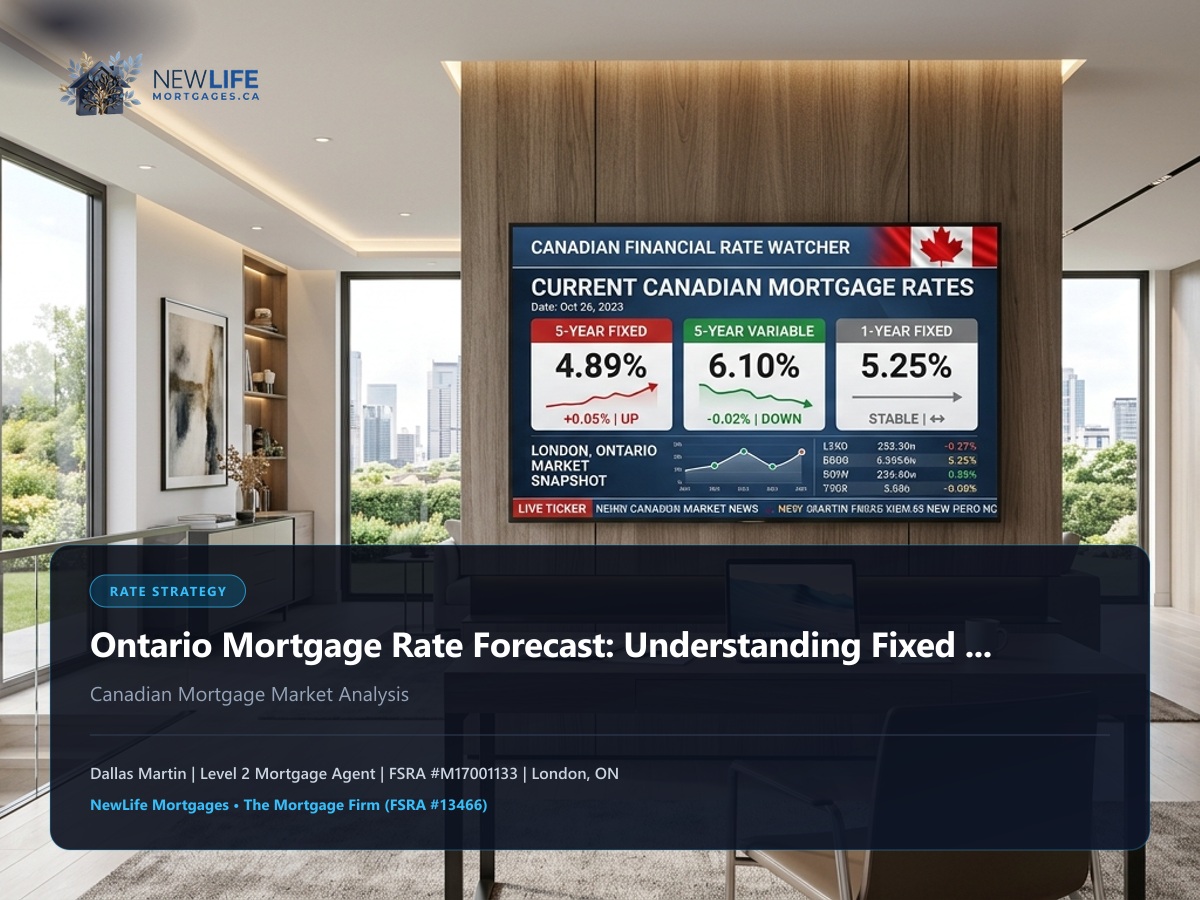
Compare Ontario fixed vs variable mortgage rates amidst Bank of Canada rate holds. Dallas Martin reveals Southwestern Ontario forecasts, yields, and rate locks.
Ontario Mortgage Rate Forecast: Fixed vs Variable Strategies
The Ontario mortgage landscape in 2026 presents Canadian property owners with a critical financial fork in the road: navigating the choice between fixed and variable rate mortgages amidst monetary stability. With the Bank of Canada holding its overnight policy rate steady at 2.25%, keeping major Canadian commercial bank prime rates anchored at 4.45%, borrowing costs have entered a period of structural equilibrium. Simultaneously, five year Government of Canada bond yields fluctuate within an active corridor between 3.18% and 3.35%, reflecting shifting domestic inflation expectations, international sovereign debt trends, and cross border trade dynamics. For home buyers and renewing property owners across London, St. Thomas, Woodstock, Strathroy, and the Greater Toronto Area, selecting the right financing structure directly dictates monthly cash flow, long term interest accumulation, and personal wealth preservation.
Operating under the regulatory oversight of the Financial Services Regulatory Authority of Ontario (FSRA) through The Mortgage Firm (FSRA Brokerage Licence #13466), NewLife Mortgages provides independent, fiduciary advisory services led by Dallas Martin (Licensed Mortgage Agent Level 2, FSRA Licence #M17001133). Frequently featured on CBC News discussing Ontario housing supply, delinquency trends, and mortgage default risks, Dallas Martin delivers institutional market intelligence that bypasses retail bank sales pressure. This eleven minute strategic forecast analyzes the macroeconomic mechanisms governing fixed and variable pricing, provides concrete mathematical models for prepayment penalties, evaluates upcoming mortgage renewal waves, and equips you with actionable strategies to secure competitive wholesale terms.
How Does the Bank of Canada Policy Rate Differ from Bond Yields in Setting Ontario Mortgage Rates?
Variable mortgage rates in Ontario move directly with commercial bank prime rates, which change with Bank of Canada overnight policy decisions. In contrast, fixed mortgage rates follow Government of Canada five year bond yields, which fluctuate daily based on inflation, economic growth, and sovereign debt markets.
A frequent point of confusion among consumers is assuming that all mortgage interest rates move in lockstep with the central bank. In truth, Canadian fixed and variable mortgages are governed by two entirely separate financial engines.
What Is the Monetary Policy Engine Driving Variable Rate Mortgages?
Variable rate mortgages (VRMs) and adjustable rate mortgages (ARMs) are tethered directly to the Canadian prime rate. Major chartered financial institutions calculate their retail prime rate by adding a standard 2.20% operating margin above the Bank of Canada overnight policy rate. With the Bank of Canada target rate held at 2.25%, the national commercial prime rate sits firmly at 4.45%.
Wholesale monoline lenders and balance sheet institutions compete by offering variable rate discounts below prime. In the current lending environment, qualified borrowers can secure prime discounts between Prime minus 0.95% and Prime minus 1.10%, resulting in effective variable mortgage rates ranging from 3.35% to 3.50% for insured financing. When the Bank of Canada convenes for its eight scheduled interest rate announcements per year, any policy adjustment immediately flows into commercial prime rates, shifting variable borrowing costs within 24 to 48 hours.
What Is the Sovereign Bond Yield Engine Driving Fixed Rate Mortgages?
In stark contrast, fixed rate mortgages do not wait for central bank policy announcements. Fixed mortgage contracts are funded through the wholesale bond market, specifically tracking the yields of Government of Canada five year sovereign bonds. Lenders price their five year fixed loans by adding an institutional liquidity and risk spread, typically 100 to 150 basis points (1.00% to 1.50%), above prevailing five year bond yields.
Because government bond yields trade continuously on open capital markets, fixed mortgage rates adjust in real time to shifting economic indicators, including consumer price index inflation reports, labor market data, and international sovereign debt yields. When five year bond yields fluctuate between 3.18% and 3.35%, wholesale insured five year fixed mortgage rates settle between 4.09% and 4.49%, while conventional uninsured terms hover between 4.64% and 4.92%. Global bond market movements alter wholesale lender funding costs within days, transmitting directly to rate sheets across Southwestern Ontario long before the Bank of Canada adjusts its overnight target.
What Is the Difference Between Fixed and Variable Mortgages in Ontario?
Fixed mortgages lock in your interest rate and monthly payment for the entire contract duration, offering total budget certainty. Variable mortgages adjust with the prime lending rate, starting with lower initial pricing but carrying fluctuating payments or shifting amortization schedules as central bank rates move.
Evaluating fixed versus variable options requires looking beyond nominal interest rates to assess contract terms, payment mechanics, and duration risk. The table below provides an objective comparison of primary financing structures currently available to Ontario borrowers:
| Product Structure | Financial Benchmark | Wholesale Rate Range | Monthly Payment Certainty | Prepayment Penalty Basis | Strategic Borrower Fit |
|---|---|---|---|---|---|
| Five Year Fixed Term | Five Year GoC Bond Yields | 4.09% to 4.49% (Insured) 4.64% to 4.92% (Conventional) |
Static payment schedule for full 60 month term | Greater of 3 months interest or Interest Rate Differential (IRD) | Households with fixed budgets and lower risk tolerance |
| Five Year Variable (ARM / VRM) | Bank of Canada Overnight Policy Rate | Prime minus 0.95% to 1.10% (Approx. 3.35% to 3.50%) |
Payments change with prime (ARM) or amortization shifts (VRM) | Capped strictly at 3 months interest across monoline lenders | Borrowers with cash flow flexibility or plans to relocate within 3 years |
| Three Year Fixed Term | Three Year GoC Bond Yields | 4.29% to 4.39% (Insured) 4.45% to 4.76% (Conventional) |
Static payment schedule for 36 months | Greater of 3 months interest or IRD (reduced duration risk) | Borrowers seeking competitive pricing who anticipate lower rates by 2028 |
For home buyers balancing affordability, the initial rate spread between a five year variable at 3.45% and a five year fixed at 4.49% represents approximately $290 per month in immediate carrying cost savings on a $500,000 mortgage. However, choosing variable debt demands financial capacity to absorb potential upward rate shocks if unexpected global macroeconomic events reignite inflationary pressures.
How Are Prepayment Penalties Calculated for Fixed Versus Variable Mortgages?
Breaking a variable mortgage in Ontario costs three months of interest, making it flexible and cost effective. Breaking a fixed mortgage typically costs the greater of three months of interest or the Interest Rate Differential, which can cost tens of thousands of dollars with a major bank.
An underappreciated underwriting liability in retail lending is the early mortgage prepayment penalty. Canadian statistics reveal that approximately 60% of Canadian borrowers refinance, break, or modify their five year mortgage contracts before reaching the 36 month mark, often triggered by job relocation, marriage, divorce, or financial restructuring. The penalty mechanism embedded in your mortgage contract can mean the difference between paying a manageable administrative fee or losing tens of thousands of dollars in accumulated property equity.
The Variable Mortgage Penalty Equation
Under federal regulations governing Canadian institutional monoline lenders, early discharge of a variable rate mortgage is legally capped at exactly three months of simple interest:
For example, if you hold a $500,000 mortgage balance at a variable rate of 3.45% and decide to sell your home or refinance, your penalty calculation is:
The Retail Bank Fixed IRD Penalty Trap
Conversely, breaking a five year fixed mortgage with an institutional Big Six commercial bank triggers an Interest Rate Differential (IRD) penalty. Rather than using wholesale discounted contract rates, retail banks calculate IRD penalties against their artificial, inflated branch posted rates:
On that identical $500,000 balance broken with 2.5 years remaining, a major bank posted rate differential easily produces an IRD penalty between $15,000 and $30,000. This predatory calculation traps borrowers into their existing loans. When working with Dallas Martin and NewLife Mortgages, our team prioritizes wholesale monoline lenders that use fair, transparent penalty calculations, protecting your equity and preserving long term mobility.
How Can Ontario Homeowners Mitigate Mortgage Renewal Payment Shock?
Ontario homeowners renewing five year fixed mortgages originally secured at 2% to 2.5% can expect payment increases averaging 20% to 25%. You can minimize this payment shock by shopping across wholesale lenders up to 120 days before maturity, avoiding the retail bank stress test on straight transfers.
Hundreds of thousands of Ontario homeowners who purchased or renewed properties in 2020 and 2021 at historic rock bottom fixed rates between 1.99% and 2.49% face upcoming mortgage maturities. Transitioning from a 2.19% fixed rate to current prevailing wholesale rates near 4.49% triggers payment shock, increasing required monthly mortgage payments by an average of 20% to 25%.
On an average Southwestern Ontario mortgage balance of $450,000 amortized over 25 years:
- Monthly payment at 2.19%: $1,947 per month
- Monthly payment at 4.49%: $2,488 per month
- Net monthly payment increase: +$541 per month (an annual cash drain of $6,492)
The OSFI Guideline B20 Straight Switch Exemption
Many renewing homeowners mistakenly assume they must accept whatever unfavorable renewal rate their current bank offers because they fear failing the mortgage stress test with another lender. Under regulations set by the Office of the Superintendent of Financial Institutions (OSFI), borrowers are fully exempt from the stress test when executing a straight switch transfer.
Homeowners can protect their monthly cash flow by bypassing the stress test on straight switch renewals. As long as your principal balance and remaining amortization period remain unchanged, you can transition your mortgage to any federally regulated wholesale lender offering lower pricing, allowing NewLife Mortgages to negotiate directly on your behalf without requiring stress test requalification.
How Do Economic Forecasts Impact Southwestern Ontario Real Estate Markets?
Stable mortgage rates support steady housing market activity across Southwestern Ontario. Lower borrowing costs improve qualification power for buyers evaluating benchmark properties in London at $662,000, St. Thomas at $584,000, and Woodstock, balancing home prices and monthly carrying costs across local communities.
Southwestern Ontario real estate fundamentals remain tightly linked to regional employment growth, manufacturing corridor expansion, and migration from the Greater Toronto Area. Understanding local housing benchmarks enables home buyers and renewing property owners to align their financing choices with real property values:
- London Ontario (Detached Benchmark: $662,000): London remains an attractive regional hub for healthcare professionals, tech workers, and growing families. Review comprehensive London Ontario housing market metrics to discover neighborhood level price movements, inventory absorption rates, and borrowing benchmarks across Masonville, Byron, and Westmount.
- St. Thomas Ontario (Average Benchmark: $584,000): Driven by electric vehicle battery manufacturing infrastructure and advanced industrial investment, St. Thomas offers exceptional value for buyers seeking detached homes at entry pricing under $600,000.
- Woodstock and Oxford County: As a strategic crossroads connecting Highway 401 and 403 corridors, Woodstock attracts industrial commuters and logistics professionals. Access specialized Woodstock industrial commuter financing for flexible mortgage solutions tailored to shift workers and automotive specialists.
- Strathroy and Middlesex County: Offering generous lot sizes and family friendly community amenities, Strathroy continues to see strong demand from buyers seeking spacious properties within easy commuting distance of Western University and Fanshawe College.
For those purchasing their first property in these communities, NewLife Mortgages assists buyers in stacking FHSA and RRSP Home Buyers Plan limits alongside land transfer tax rebates, turning government incentive programs into substantial down payment equity.
Frequently Asked Questions About the Ontario Mortgage Rate Forecast
Is it better to get a fixed or variable mortgage in Ontario right now?
Choosing between a fixed or variable mortgage in Ontario depends on your budget stability and timeline. Five year variable rates offer lower initial payments at roughly 3.35% to 3.50%, compared to 4.49% for fixed rates. However, a fixed mortgage guarantees predictable payments, protecting your household against unexpected interest rate increases.
Borrowers with strict debt service limits and zero tolerance for payment variability benefit from five year fixed rates near 4.49%, ensuring complete shelter from economic shocks. Conversely, home buyers with stable surplus income or those anticipating selling within three years can leverage variable rates near 3.45% to maximize monthly cash flow and secure low three month interest prepayment penalties.
Will mortgage rates go down in Ontario in 2026?
Ontario mortgage rates are expected to remain relatively flat through 2026. The Bank of Canada has held its overnight policy rate at 2.25%, keeping variable rates steady. Fixed mortgage rates, however, may fluctuate slightly because they follow Government of Canada bond yields rather than central bank policy changes.
While the Bank of Canada has paused its rate cutting cycle to ensure headline inflation remains sustainably near the 2% target, fixed mortgage rates continue to fluctuate independently alongside sovereign bond yields. Global capital movements, federal deficit financing, and supply chain updates can nudge bond yields up or down by 20 to 40 basis points even while central bank policy remains on hold.
How much will my Ontario mortgage payment increase when I renew?
Ontario homeowners renewing five year fixed mortgages originally secured at 2% to 2.5% can expect payment increases averaging 20% to 25%. You can minimize this payment shock by shopping across wholesale lenders up to 120 days before maturity, avoiding the retail bank stress test on straight transfers.
Homeowners moving from pandemic era fixed rates into current market pricing can expect their payments to increase by roughly $100 to $125 per month for every $100,000 in mortgage debt. Initiating a wholesale review four to six months before maturity allows borrowers to explore straight switch lender transfers or re amortize debt to stabilize household finances.
What is the penalty for breaking a fixed versus variable mortgage in Ontario?
Breaking a variable mortgage in Ontario costs three months of interest, making it flexible and cost effective. Breaking a fixed mortgage typically costs the greater of three months of interest or the Interest Rate Differential, which can cost tens of thousands of dollars with a major bank.
Breaking a variable mortgage costs three months of interest, representing approximately $4,000 to $5,000 on a $500,000 balance. Breaking a fixed term with a Big Six bank requires paying an Interest Rate Differential penalty calculated against artificial posted rates, frequently resulting in penalties between $15,000 and $30,000.
How Do You Secure a 120 Day Wholesale Rate Lock with NewLife Mortgages?
Securing a 120 day wholesale rate lock protects your pre approval or renewal against bond market volatility with zero financial obligation. Dallas Martin monitors wholesale lender sheets to guarantee your rate ceiling while letting you capture any downward rate drops prior to closing.
Timing interest rate fluctuations is impossible, but insulating your family from market volatility is completely within your control. Working with Dallas Martin at NewLife Mortgages grants you access to wholesale rate locks spanning up to 120 days. If bond yields surge while you shop for a home or wait for your renewal date, your locked rate is fully guaranteed. If wholesale lender rates drop before closing, your rate automatically floats down to the lower number.
Fiduciary Brokerage Representation and Professional Credentials
Authored by Dallas Martin, Licensed Mortgage Agent Level 2 (FSRA Licence #M17001133) with NewLife Mortgages, operating under The Mortgage Firm (FSRA Brokerage Licence #13466).
London Regional Office: 204 Oxford Street West, London, Ontario, N6H 1S4 | Direct Telephone: (519) 495 7250 | Email: dallas@themortgagefirm.ca
Licensed by the Financial Services Regulatory Authority of Ontario (FSRA). All mortgage approvals, rate locks, and refinancing transactions are subject to lender underwriting criteria, property appraisal, and OSFI Guideline B20 regulatory compliance.
Our Trusted Lenders
Through our partnership with The Mortgage Firm, we negotiate directly with Canada's top institutional and private equity lenders.