Strathroy and Middlesex County Rural Mortgages: Navigating Well, Septic, and Acreage Guidelines in Ontario
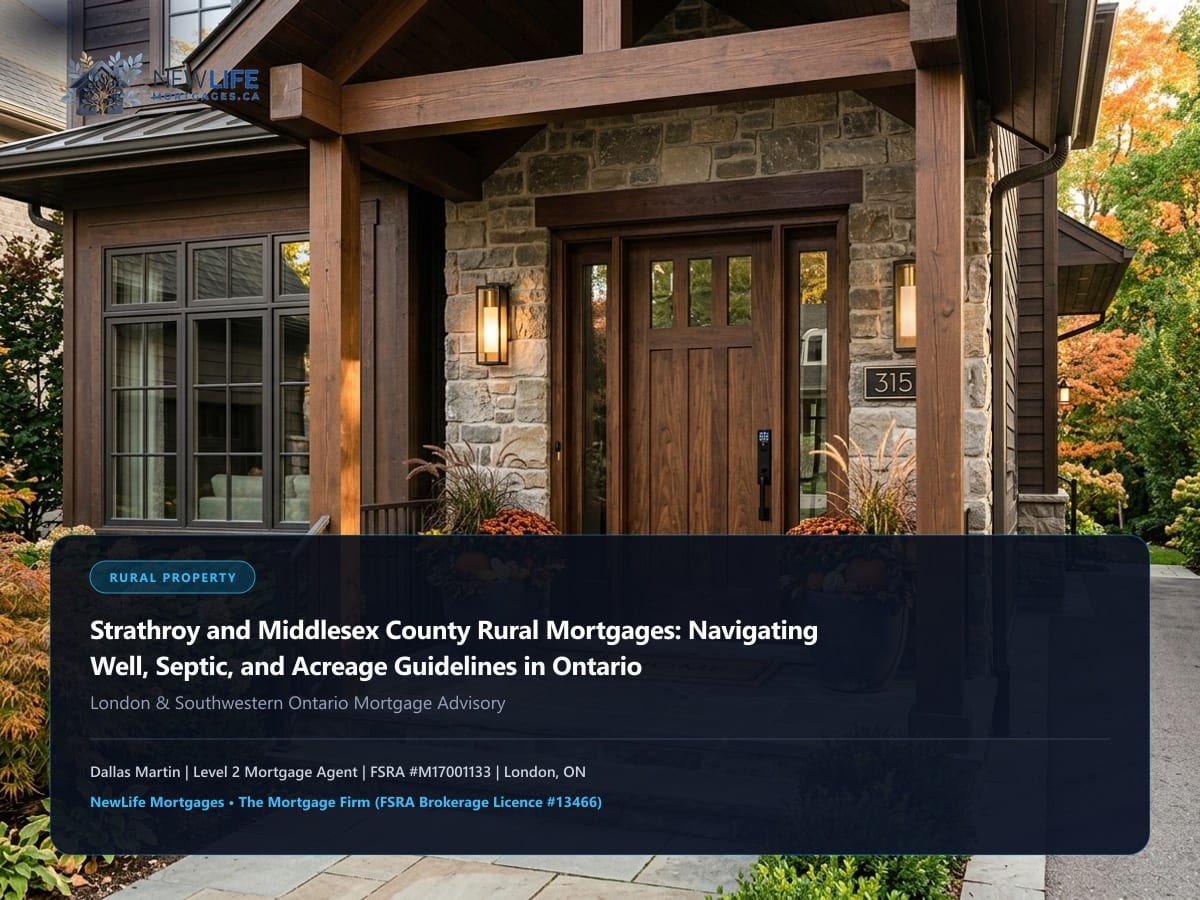
Explore the unique challenges and solutions for financing rural properties in Strathroy and Middlesex County, Ontario. This guide details mortgage requirements for well and septic systems, acreage limits, and outbuilding valuations, with expert insights from Dallas Martin, Licensed Mortgage Agent Level 2.
Purchasing a home in the picturesque rural landscapes of Strathroy and the broader Middlesex County offers a unique lifestyle, often characterized by more space, tranquility, and a connection to nature. However, the path to financing these properties differs significantly from obtaining a mortgage for an urban dwelling in London or even a suburban home in Woodstock. The presence of private well water, septic systems, expansive acreage, and various outbuildings introduces a layer of complexity to the mortgage underwriting process that prospective buyers must thoroughly understand.
As Dallas Martin, Licensed Mortgage Agent Level 2 (FSRA Licence #M17001133) at NewLife Mortgages with The Mortgage Firm (FSRA Brokerage Licence #13466), I frequently guide clients through these specific challenges. The current macroeconomic climate, marked by a Bank of Canada policy interest rate of 2.25% and a major commercial bank prime rate of 4.45%, alongside a 5-year Government of Canada bond yield of 3.54%, means that every aspect of mortgage qualification, especially for non-standard properties, is under scrutiny. This exhaustive guide aims to demystify rural mortgage guidelines in Ontario, providing mathematically supported insights and regulatory analysis to empower your homeownership journey in Southwestern Ontario.
What Makes Financing a Rural Property in Strathroy Different from Urban Mortgages?
Rural properties in Strathroy and Middlesex County often require specialized mortgage underwriting due to factors like private water (wells), wastewater (septic systems), larger acreage, and outbuildings, which differ significantly from standard urban property assessments.
The fundamental distinction in rural mortgage financing stems from a lender's risk assessment. In urban settings, properties are typically connected to municipal services (water, sewer, gas), have standardized lot sizes, and are appraised based on a robust pool of comparable sales. Rural properties, by contrast, present unique variables:
- Private Services: The reliance on private well water and septic systems shifts the responsibility for these critical utilities entirely to the homeowner. Lenders view potential issues with these systems as significant risks, as they can severely impact property value and habitability.
- Acreage and Land Value: While urban appraisals focus heavily on the structure, rural appraisals must carefully delineate the value of the dwelling from the value of the land. Lenders often have limits on how much acreage they will consider "residential" for mortgage purposes, typically focusing on a "house plus 5 acres" model for conventional financing. Excess acreage may be discounted or require specialized agricultural lending.
- Outbuildings: Barns, detached garages, workshops, and other outbuildings are common on rural properties. Their valuation for mortgage purposes is not always straightforward; lenders often only assign value if they directly contribute to the residential utility of the property, discounting or ignoring those that are purely agricultural or in disrepair.
- Comparability: Finding truly comparable sales (comps) for rural properties can be challenging due to the diversity in lot sizes, property features, and unique land attributes, leading to more complex appraisal processes.
These distinctions necessitate a more thorough due diligence process from both the borrower and the lender, often involving specific inspections and a deeper understanding of regional property norms in areas like Strathroy, St. Thomas, and Woodstock.
How Do Private Well and Septic Systems Impact Mortgage Approval in Middlesex County?
Private well and septic systems are critical underwriting factors for rural mortgages in Middlesex County, requiring satisfactory potability tests for wells and functional inspections for septic systems to ensure health, safety, and property value.
For lenders, the functionality and safety of private water and waste systems are paramount. A malfunctioning well or septic system can render a property uninhabitable, significantly depreciating its value and increasing the lender's risk exposure. Consequently, specific documentation and satisfactory results from certified professionals are almost always mandatory.
What Are the Requirements for Well Water Testing and Potability?
Lenders typically require a recent well water potability test, usually within 90 to 180 days, confirming the water is safe for consumption and free from harmful bacteria like E. coli and coliform, alongside a flow rate test proving adequate water supply.
A well water potability test is a non-negotiable requirement for rural mortgages. The test, conducted by an accredited laboratory, assesses the water quality for contaminants. The most crucial aspect is the absence of bacterial indicators such as E. coli and total coliform. Elevated levels often indicate contamination from surface water or septic systems, posing a serious health risk. A "pass" result is mandatory. Furthermore, a flow rate test is often required to ensure the well can provide a consistent and adequate supply of water, typically measured in gallons or litres per minute, for the household's needs.
If a well fails the potability test, the lender may require remediation (e.g., shock chlorination, UV filtration system installation) and a re-test before approving the mortgage. In cases where remediation is impossible or excessively costly, the property may not qualify for conventional financing, or the purchase price may need significant adjustment.
What Do Septic System Inspections Entail for Mortgage Approval?
Septic system inspections for mortgage approval evaluate the tank's integrity, leach field functionality, and overall system compliance with provincial regulations, often requiring a qualified professional to confirm the system is in good working order and has sufficient capacity for the dwelling.
Similar to well tests, a professional septic inspection is critical. This typically involves a qualified septic inspector or engineer assessing the entire system, from the tank to the distribution box and leach field. Key aspects include:
- Tank Condition: Checking for cracks, leaks, proper baffling, and sludge levels.
- Leach Field Performance: Ensuring the effluent is properly dispersed and absorbed into the soil, with no signs of surfacing wastewater or backups.
- System Capacity: Verifying the system is appropriately sized for the number of bedrooms in the home.
- Permit and Maintenance History: Lenders may request records of the system's installation permit and regular pump-outs.
Should the septic system fail inspection, requiring costly repairs or replacement, the lender will likely make mortgage approval conditional on these repairs being completed and verified prior to closing. This can introduce significant delays and additional expenses for the buyer or seller.
What Are the Acreage Limits and Outbuilding Valuation Rules for Rural Mortgages in Ontario?
Lenders typically limit the financed acreage for rural properties to 10 acres (often 5 acres for prime lenders) beyond the house footprint, while valuing outbuildings like barns or detached garages only if they contribute functionally to the property's residential use.
The size of the land parcel is a significant factor in rural mortgage underwriting. For most prime lenders, the standard rule of thumb is to consider the "house plus 5 acres" as the primary collateral for a conventional residential mortgage. Any acreage beyond this threshold may be assigned a reduced value or excluded entirely from the appraisal used for lending purposes.
Some lenders may extend this up to 10 acres for properties zoned purely residential-rural, but anything larger, especially if it has an agricultural component, often requires a specialized appraisal and may necessitate an alternative lending solution or a larger down payment. For example, a 50-acre farm with a residence would likely be considered an agricultural property, falling outside the scope of standard residential mortgages.
Outbuildings, while adding to the property's appeal and utility for a homeowner, are not always valued dollar-for-dollar by lenders. A large, dilapidated barn might contribute very little to the mortgage value compared to a well-maintained detached garage or workshop that directly enhances the residential function of the property. Lenders look for "functional utility" – does the outbuilding serve the primary residential use of the property? If an outbuilding is deemed non-functional, in poor repair, or primarily agricultural on a residential-focused loan, its value may be heavily discounted or even ignored in the appraisal for lending purposes.
Does the Type of Water and Waste System Affect My Mortgage Payment on a $625,000 Strathroy Home?
While the type of water and waste system doesn't directly alter the mortgage payment calculation itself, it significantly influences initial closing costs, appraisal requirements, and the overall eligibility for specific mortgage products and competitive rates.
The actual calculation of your monthly mortgage payment is based on the principal loan amount, interest rate, and amortization period. However, the presence of private well and septic systems adds layers of upfront costs and potential ongoing maintenance that are crucial to budget for. For our example, let's consider a $625,000 single-family home in Strathroy on a half-acre lot with municipal water and private septic, financed with a conventional 20% down payment mortgage at 3.99% fixed for a five-year term with a 25-year amortization.
- Purchase Price: $625,000
- Down Payment (20%): $125,000
- Mortgage Amount: $500,000
- Interest Rate: 3.99% (fixed, five-year term)
- Amortization Period: 25 years
Monthly Payment Calculation Formula:
M = P [ i(1 + i)^n ] / [ (1 + i)^n – 1]
Where:
- M = Monthly Payment
- P = Principal Loan Amount ($500,000)
- i = Monthly Interest Rate (Annual Rate / 12) = 3.99% / 12 = 0.003325
- n = Total Number of Payments (Amortization in Years * 12) = 25 * 12 = 300
Therefore, the estimated monthly mortgage payment would be approximately $2,630.00.
While the calculation above is standard, the direct costs associated with the septic system include inspection fees (typically $400-$800) and potential repair costs if issues are found. For properties with private wells, there are similar inspection and testing fees ($150-$300). These are upfront costs that impact your overall affordability and cash flow at closing, even if they don't directly alter the monthly principal and interest payment.
Can Self-Employed Borrowers Qualify for Rural Mortgages in Middlesex County with Stated Income?
Self-employed borrowers can qualify for rural mortgages in Middlesex County using stated income programs, provided they have a minimum 20% down payment (maximum 80% LTV) and demonstrate consistent business activity, offering a viable path for those with complex tax situations.
For self-employed individuals in rural Middlesex County, qualifying for a prime mortgage can sometimes be challenging if their declared taxable income is minimized for tax purposes. Traditional lenders primarily assess income based on Notice of Assessment (NOA) figures. However, specialized "stated income" or "alternative income" programs are available through alternative lenders, designed to accommodate entrepreneurs and business owners whose true earning capacity may not be fully reflected on their tax returns.
A critical requirement for these programs, especially for rural properties, is a minimum down payment of 20%, meaning a maximum Loan-to-Value (LTV) of 80%. This higher equity injection mitigates the lender's risk, particularly for properties with unique rural characteristics. Instead of NOAs, lenders in these programs typically rely on:
- Bank Statements: Demonstrating consistent deposits and cash flow into business and personal accounts over a period of 6 to 12 months.
- Business Financials: Review of unaudited financial statements, T1 Generals, or professional letters verifying income.
- Credit History: A strong credit score and clean payment history are essential to offset the reduced documentation of income.
While these programs offer flexibility, they often come with slightly higher interest rates or fees compared to prime mortgages. However, for a self-employed individual looking to purchase a rural property in Strathroy, this can be a crucial pathway to homeownership, allowing them to qualify based on their actual business revenue rather than just their net taxable income. Dallas Martin, Licensed Mortgage Agent Level 2, specializes in connecting self-employed clients with the right alternative lending solutions.
What is the Process for Securing a Rural Mortgage in Strathroy, Ontario?
Securing a rural mortgage in Strathroy involves pre-approval, property search, conditional offer, mandatory property-specific inspections (well, septic), appraisal, and final approval, often requiring more specialized expertise due to unique rural property considerations.
The process for securing a rural mortgage shares fundamental steps with urban mortgages but includes critical additional considerations specific to the property type. Navigating these nuances effectively is key to a smooth closing:
- Mortgage Pre-Approval: Start here. A comprehensive pre-approval with Dallas Martin, Licensed Mortgage Agent Level 2, will assess your financial capacity and identify potential lending programs suitable for rural properties. This also locks in a rate for up to 120 days, protecting you from market fluctuations.
- Property Search & Offer: With pre-approval in hand, you can confidently search for your ideal rural home in Strathroy or Middlesex County. When making an offer, it is absolutely critical to include conditions for satisfactory well water potability tests, septic system inspections, and a property appraisal.
- Well and Septic Inspections: Once your offer is accepted, these specialized inspections must be arranged promptly. Engage certified professionals to conduct the tests and provide detailed reports. The results directly impact the lender's willingness to finance and the property's appraised value.
- Appraisal: The lender will commission an appraisal to determine the property's fair market value. For rural properties, the appraiser will pay close attention to the acreage, the condition and utility of outbuildings, and the functionality of well and septic systems. They will also seek comparable sales, which can be more challenging to find in rural areas.
- Underwriting & Final Approval: The lender's underwriter will review all documentation, including the well/septic reports and appraisal. Any conditions requiring repairs or further documentation must be met before final mortgage approval is granted.
- Closing: Once all conditions are satisfied and funds are released, you take possession of your new rural home.
Throughout this process, Dallas Martin, Licensed Mortgage Agent Level 2, provides expert guidance, helping you understand lender expectations and coordinate the necessary inspections and documentation for your unique rural property.
How Do Lender Underwriting Requirements Compare for Rural Properties?
← Back to Main Blog Page
Ready to Run Your Exact Mortgage Numbers With Dallas Martin?
Skip the retail bank branch guesswork. Speak directly with Dallas Martin, Licensed Mortgage Agent Level 2 (FSRA Licence #M17001133) for a custom debt service calculation, 120-day wholesale rate hold, or same-day pre-approval across London, St. Thomas, Woodstock, and Strathroy.