How to Qualify for a Mortgage in London, Ontario in 2026
A comprehensive search optimized guide to qualifying for a mortgage in London Ontario under the latest guidelines.
Unlocking Your Borrowing Leverage in the London Ontario Housing Market
Buying a home in London Ontario under the 2026 lending guidelines requires a clear understanding of qualifying parameters. With London's benchmark housing price hovering around the $600,000 to $650,000 mark in early 2026, buyers who prepare their files early are securing the most competitive wholesale rates. Whether you are working with a mortgage broker London Ontario for your first purchase or moving up the property ladder, this guide maps out the exact underwriting criteria used by major institutional and alternative lenders.
The Core Qualifying Criteria: Credit, Income, and Debt Ratios
Lenders evaluate your mortgage application based on three key pillars. Gross Debt Service (GDS) and Total Debt Service (TDS) ratios are the two primary mathematical ratios lenders calculate to measure your ability to afford monthly housing costs. These ratios compare your pre-tax household income against your monthly expenses.
Debt Service Ratio Calculations
$$\text{GDS} = \frac{\text{Principal} + \text{Interest} + \text{Property Taxes} + \text{Heating Costs} + 50\%(\text{Condo Fees})}{\text{Gross Annual Income}}$$
$$\text{TDS} = \frac{\text{Housing Costs} + \text{Car Loans} + \text{Student Loans} + \text{Credit Cards} + \text{Personal Loans} + \text{Lines of Credit}}{\text{Gross Annual Income}}$$
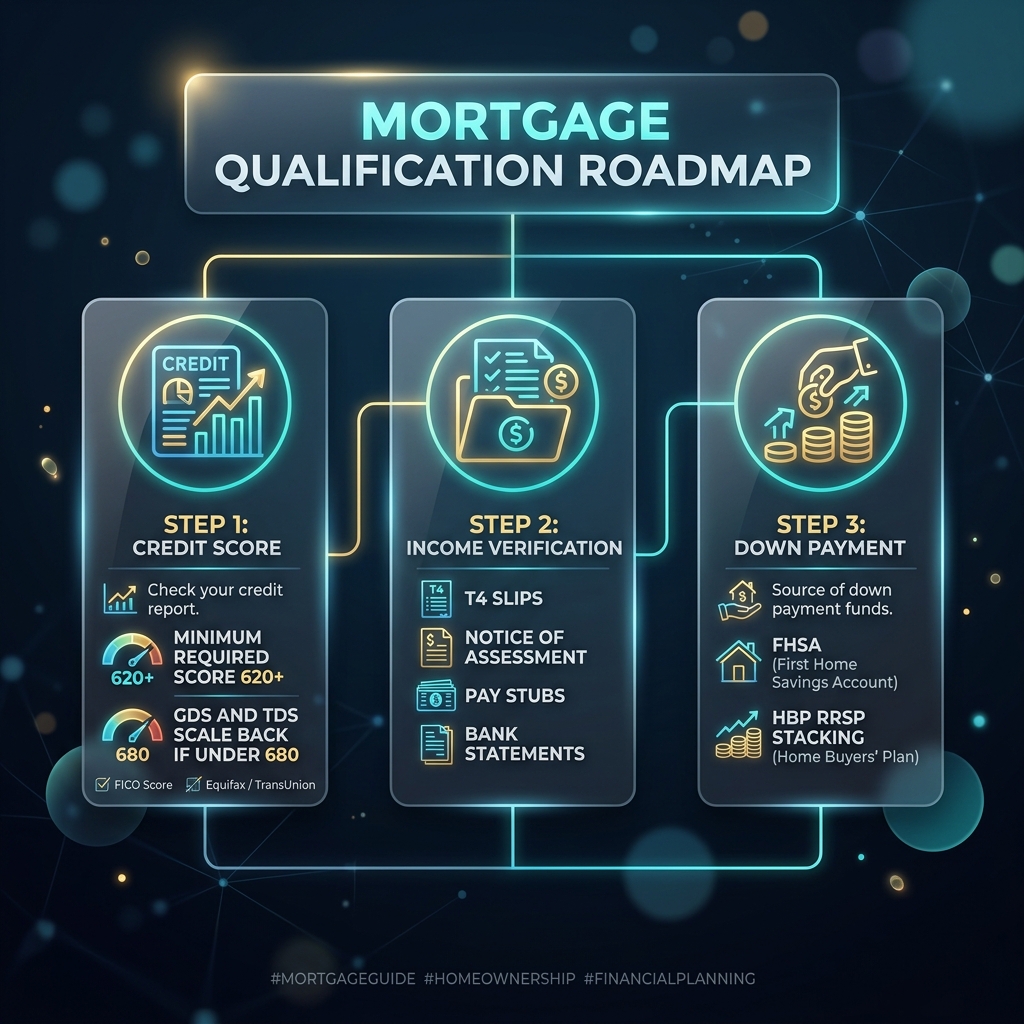
Under default insurer guidelines, credit scores dictate the maximum GDS and TDS percentages you are allowed to reach. Lenders categorize credit scores into distinct tiers, each carrying distinct guidelines:
| Credit Score Class | Score Range | Primary Funding Channel | Max GDS Cap | Max TDS Cap | Underwriting Adjustments |
|---|---|---|---|---|---|
| Excellent / Elite | 760–900 | Prime Wholesale / Monoline | 39% | 44% | Access to lowest promotional rates |
| Strong / Good | 680–759 | Prime Wholesale / Monoline | 39% | 44% | Standard prime guidelines apply |
| Fair / Moderate | 600–679 | Prime Insured / Restructured | 35% | 42% | GDS/TDS caps scaled back by underwriters |
| Poor / Subprime | 500–599 | Alternative B-Lenders / MICs / Private Equity | Discretionary | Up to 50% - 65%+ | Higher rates, lender fees, and shorter terms |
While the statutory credit score floor for a high-ratio insured mortgage is 600, most prime wholesale lenders reduce the GDS and TDS limits to 35% and 42% for profiles with scores under 680 to mitigate credit risk.
2026 Home Purchase Qualifier (London Ontario)
Calculate your maximum buying power using official GDS/TDS debt service thresholds (39% / 44%) and the 2026 mortgage stress test.
Qualifying Estimate
Income Documentation: Preparing Your File
Documenting your income correctly is the most critical step in avoiding closing day delays. Lenders require specific paperwork depending on your employment structure:
Standardized Qualification Document Checklist
| Borrower Category | Required Verification Documents | Key Underwriting Metrics Evaluated |
|---|---|---|
| Salaried / Hourly Employee |
|
|
| Self-Employed (BFS Alt-A) |
|
|
If you are self-employed and cannot verify your income using traditional tax documents, you can access specialized stated income programs that verify borrowing capacity using corporate bank statements instead of tax returns.
Understanding Down Payment Rules and the $1.5 Million Insured Cap
In Canada, home buyers can obtain mortgage default insurance with a down payment of less than 20% for properties priced below $1.5 million. The minimum down payment is determined by a progressive tiered formula: 5% on the first $500,000, plus 10% on the remaining balance up to $1,499,999. Properties priced at $1,500,000 or higher require a flat, conventional down payment of at least 20%.
For example, a property priced at $1,200,000 requires a minimum down payment of $95,000, calculated as:
$$\text{Down Payment} = (5\% \times \$500,000) + (10\% \times \$700,000) = \$25,000 + \$70,000 = \$95,000$$
Case Study: Verification of a Core Mortgage Qualification Scenario
To demonstrate how these rules apply in a real-world scenario, consider a homebuyer household with the following financial profile:
- Annual Gross Income: $120,000 ($10,000 per month)
- Monthly Non-Housing Debt Liabilities: $400
- Down Payment Savings: $50,000
- Estimated Credit Score: 720 (Prime Tier)
- Contract Interest Rate: 3.99%
- Stressed Qualifying Rate: 5.99% (Contract Rate + 2.00%)
Using these variables, the maximum qualifying purchase budget is determined to be $539,300, with a base mortgage principal of $489,300. The math behind this approval breaks down as follows:
1. Loan-to-Value (LTV) and Default Insurance Premium
With a purchase price of $539,300 and a $50,000 down payment, the base LTV ratio is calculated as:
$$\text{LTV} = \frac{\$539,300 - \$50,000}{\$539,300} = 90.73\%$$
Because the LTV falls in the 90.01% to 95.00% bracket, the standard default insurance premium is 4.00% of the loan amount. This premium is capitalized onto the base mortgage principal:
$$\text{Capitalized Mortgage Principal} = \$489,300 \times 1.04 = \$508,872$$
2. Monthly Payment Comparison
Amortizing this capitalized principal over 25 years using Canadian semi-annual compounding yields the following monthly payments:
- Actual Monthly Payment (3.99% contract rate): $2,670 per month (the borrower's actual out-of-pocket cost).
- Stressed Monthly Payment (5.99% stress test rate): $3,254 per month (the payment used to calculate GDS/TDS ratios).
For a household with $10,000 gross monthly income, the stressed payment of $3,254 represents a GDS ratio of 32.54%, which is safely below the 39% maximum GDS ceiling, proving qualification.
The 2026 Mortgage Stress Test and Exemption Windows
Every homebuyer in Ontario must qualify under the federal stress test rules. The qualifying interest rate is defined as the higher of your contract interest rate plus 2.00%, or the government floor rate of 5.25%:
$$\text{Qualifying Rate} = \max(\text{Contract Interest Rate} + 2\%, \, 5.25\% \text{ Floor Rate})$/p>
For standard prime fixed contract rates of 3.99%, the calculation is structured as:
$$\text{Qualifying Rate} = \max(3.99\% + 2\%, \, 5.25\%) = 5.99\%$$
Exemption Windows for Straight-Switch Renewals
A key regulatory easement is the switch renewal exemption rules. Borrowers looking to transfer their mortgage to a new lender at renewal can bypass the stress test under three distinct exemption paths:
- Transactionally Insured Mortgages: High-ratio insured mortgages (down payment under 20%) can switch lenders at renewal stress-test free.
- Portfolio-Insured Mortgages: Low-ratio conventional mortgages where the lender purchased bulk default insurance are also exempt.
- Uninsured Conventional Mortgages: Under the latest OSFI policy guidelines, uninsured conventional mortgages can be transferred to any federally regulated lender at renewal without stress test requalification.
The 'Straight-Switch' Requirement: To maintain this stress-test exemption, the transaction must be a pure straight switch. The outstanding principal balance cannot be increased, and the remaining amortization schedule cannot be extended. If the borrower accesses home equity or extends the term, it is classified as a refinance and requires full qualification under the stress test.
Comparative Insurance Premium Structures and Stated Income Options
High-ratio mortgage default insurance is provided by CMHC, Sagen, and Canada Guaranty. Standard premium rates are consistent across all three providers, but they apply specialized premium structures for stated income programs.
Standard High-Ratio Default Insurance Premiums
For owner-occupied homes with amortizations of 25 years or less, standard premium rates are structured as follows:
| Loan-to-Value (LTV) Ratio | Corresponding Down Payment | Standard Premium Rate | 30-Year Amortization Surcharge |
|---|---|---|---|
| Up to 65.00% | 35.00% or more | 0.60% | +0.20% |
| 65.01% to 75.00% | 25.00% to 34.99% | 1.70% | +0.20% |
| 75.01% to 80.00% | 20.00% to 24.99% | 2.40% | +0.20% |
| 90.01% to 95.00% | 5.00% to 9.99% | 4.00% | +0.20% |
*Note: A mandatory 0.20% surcharge is added to the premium rate for 30-year amortizations, which are accessible to qualified first-time buyers and purchasers of newly constructed properties.
Self-Employed Stated Income (Alt-A) Insurance Premiums
For business owners verifying income through alternative low-documentation methods, private insurers apply specialized premium structures:
| Loan-to-Value (LTV) Ratio | Sagen BFS Alt-A Premium | Canada Guaranty Low Doc Premium | Standard Premium Reference |
|---|---|---|---|
| Up to 65.00% | 1.50% | 1.50% | 0.60% |
| 65.01% to 75.00% | 2.60% | 2.60% | 1.70% |
| 75.01% to 80.00% | 3.30% | 3.30% | 2.40% |
Self-employed stated income programs are capped at a maximum LTV of 80.00% (requiring a minimum 20% down payment).
Macroeconomic Credit Environment and the Loan-to-Income (LTI) Cap
To manage record-high household debt levels, the Office of the Superintendent of Financial Institutions (OSFI) has implemented strict portfolio-level restrictions for federally regulated banks. Under these rules, lenders must limit new uninsured mortgages that exceed a Loan-to-Income (LTI) ratio of 4.5 times gross annual income. Specifically, no more than 15 percent of a lender's new uninsured originations can exceed the 4.5x LTI threshold.
This creates a dual-barrier environment. A borrower might pass the stressed GDS/TDS test, but still face approval restrictions if the lender has exhausted its quarterly LTI room. To succeed in this market, applicants are partnering with independent brokerages who can access non-federally regulated institutions, credit unions, or alternative lenders exempt from the LTI portfolio cap.
Rental Income Offsets for Qualifying Ratios
For buyers of multi-unit properties or homes with secondary suites, rental income can act as a powerful offset. In standard investment properties, CMHC and private insurers allow lenders to apply up to a 50 percent rental income offset directly to the borrower's gross qualifying income.
Crucially, for owner-occupied two-unit properties (such as a home with a legal basement secondary suite), CMHC allows up to a 100 percent rental offset of the projected gross rent, helping buyers reduce their calculated GDS/TDS ratios and secure prime financing that would otherwise be out of reach.
Expert Guidance from a Licensed Professional
Securing a mortgage is more than just finding the lowest rate online. It requires matching your personal financial profile with the underwriting guidelines of Canada's top institutional lenders. Dallas Martin is a licensed Mortgage Agent Level 2 (FSRA License #M17001133) operating under The Mortgage Firm (FSRA Brokerage Licence #13466). With access to over 50 lenders, Dallas specializes in structuring custom mortgages for first time buyers, self-employed individuals, and families looking to refinance or access home equity. First time purchasers can also study our pillar breakdown on down payment stacking with the FHSA and RRSP Home Buyers Plan in Ontario to learn how couples pool up to $200,000 tax free. Contact Dallas Martin today to start your pre-qualification audit.
Our Trusted Lenders
Through our partnership with The Mortgage Firm, we negotiate directly with Canada's top institutional and private equity lenders.