Stacking FHSA & RRSP in Ontario: 2026 First Time Buyer Guide
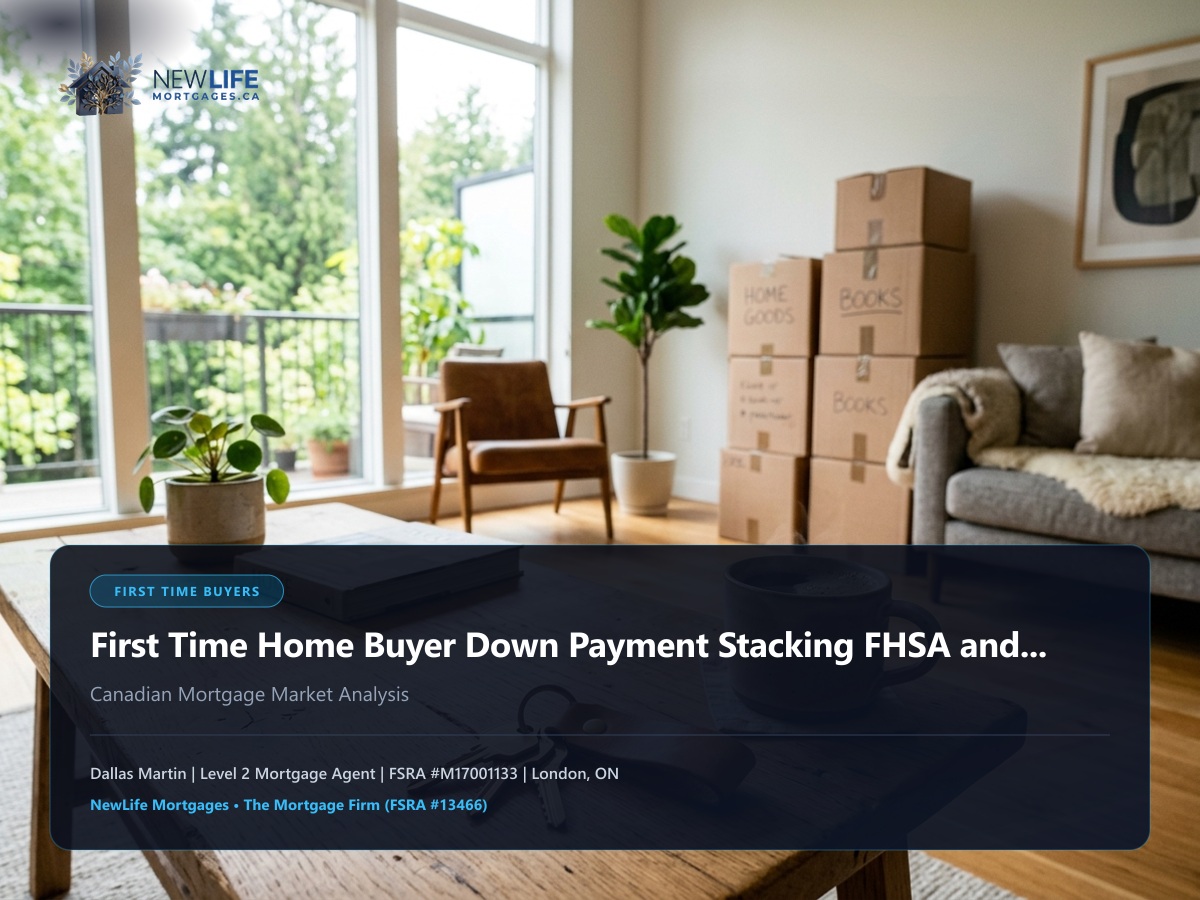
Learn how Ontario first time buyers stack the FHSA and RRSP Home Buyers Plan to access $200,000 tax free. Eliminate CMHC fees and maximize down payments.
Stacking FHSA & RRSP in Ontario: 2026 First Time Buyer Guide
For aspiring property buyers in Ontario, assembling a competitive down payment in today economic environment requires tactical precision and deep understanding of Canadian tax legislation. Navigating housing markets across London, Woodstock, Strathroy, and St. Thomas demands moving beyond traditional after tax bank savings. By systematically coordinating federal registered accounts, Ontario first time home buyers can assemble up to $200,000 in pooled, tax sheltered capital to fund their home acquisition. Operating under the regulatory purview of the Financial Services Regulatory Authority of Ontario (FSRA) through The Mortgage Firm (FSRA Brokerage Licence #13466), NewLife Mortgages provides fiduciary underwriting advisory led by Dallas Martin (Licensed Mortgage Agent Level 2, FSRA Licence #M17001133). Frequently featured on CBC News discussing Ontario housing supply, debt service stress tests, and mortgage default risks, Dallas Martin delivers institutional capital stacking strategies designed to eliminate unnecessary insurance premiums, maximize tax deductions, and accelerate homeownership.
Can you combine the FHSA and RRSP Home Buyers Plan in Ontario?
Yes, eligible first time home buyers in Ontario can combine the First Home Savings Account and RRSP Home Buyers Plan for the same purchase without penalty. Combining both programs enables an individual to deploy up to $100,000 and a spousal couple to pool up to $200,000 in tax deductible down payment funds.
Canadian federal lending and tax statutes explicitly permit eligible first time purchasers to deploy both the First Home Savings Account (FHSA) and the Registered Retirement Savings Plan Home Buyers Plan (HBP) on the same residential real estate purchase. Rather than forcing you to choose between individual programs, the Department of Finance designed these accounts to complement one another, creating an unprecedented capital accumulation engine.
When an individual purchases a qualifying home in Ontario, they can extract their lifetime FHSA balance tax free while simultaneously withdrawing up to $60,000 from their RRSP under the expanded HBP rules enacted in federal legislation. When two partners purchase jointly as spouses or common law partners, each individual can leverage their own independent registered accounts, unlocking an aggregate $200,000 down payment reserve ($80,000 from dual FHSAs plus $120,000 from dual RRSP HBPs).
How much can a couple withdraw from FHSA and RRSP for a down payment?
Under Canadian federal rules, a couple buying their first home can withdraw up to $200,000 tax free. This includes $40,000 from each partner First Home Savings Account totaling $80,000, alongside $60,000 from each partner RRSP through the expanded Home Buyers Plan totaling $120,000 in unencumbered down payment capital.
To understand the full statutory mechanics of these accounts, review the comparison table below detailing contribution ceilings, tax deductibility, and withdrawal rules across primary Canadian savings vehicles:
| Regulatory Attribute | First Home Savings Account (FHSA) | RRSP Home Buyers Plan (HBP) | Tax Free Savings Account (TFSA) |
|---|---|---|---|
| Annual Contribution Ceiling | $8,000 per calendar year | Constrained by individual RRSP deduction room | Indexed statutory allowance ($7,000 base) |
| Cumulative Lifetime Ceiling | $40,000 plus compound portfolio returns | $60,000 maximum withdrawal per tax filer | Cumulative room accrued since age 18 |
| Contribution Tax Deductibility | 100% deductible against gross taxable income | 100% deductible against gross taxable income | Zero deduction; funded via net after tax savings |
| Withdrawal Taxation Status | 100% tax free for qualifying home purchase | Tax free at withdrawal; subject to repayment terms | 100% tax free liquidity at any time |
| Mandatory Repayment Terms | None; capital remains permanently unencumbered | 15 year straight line schedule (1/15th per year) | None; withdrawn amounts re credit contribution room |
| Statutory Repayment Grace Period | Not applicable | 5 year grace period on eligible withdrawals | Not applicable |
| Mandatory Fund Holding Window | No statutory holding period prior to withdrawal | Contributed funds must reside in RRSP for at least 89 days | Immediate liquidity with zero holding restrictions |
| Non Purchase Account Resolution | Direct rollover into RRSP or RRIF without room penalty | Capital remains preserved inside existing RRSP shelter | Capital remains preserved inside existing TFSA shelter |
Do you have to pay back an FHSA withdrawal in Canada?
No, qualifying withdrawals from a First Home Savings Account used to purchase a home never need to be repaid. Unlike the RRSP Home Buyers Plan, which mandates a 15 year straight line repayment schedule, qualifying FHSA funds remain completely tax free and permanently unencumbered.
The structural difference between the FHSA and the RRSP HBP is one of the most critical legal distinctions in Canadian real estate conveyancing. The FHSA operates as an outright grant style registered vehicle. When qualifying funds are withdrawn to close on your primary home using Canada Revenue Agency Form RC725 (Qualifying Withdrawal Request to Acquire a Qualifying Home), those funds are 100% tax free and never require repayment.
In contrast, the RRSP Home Buyers Plan operates as a tax deferred loan taken against your own accumulated retirement savings. Borrowers must submit CRA Form T1036 (Home Buyers Plan Request to Withdraw Funds from an RRSP). Under federal rules, participants enjoy an expanded five year grace period before repayments commence. Following the grace period, borrowers must repay the withdrawn balance across a 15 year straight line schedule, allocating 1/15th of the original withdrawal back into their RRSP annually. If you fail to repay your required annual installment, the missing portion is declared as unallocated income and added directly to Line 15000 of your T1 General personal income tax return for that year, where it is taxed at your full marginal rate.
How long does money need to be in an RRSP before an HBP withdrawal?
Under Canada Revenue Agency rules, contributions must reside within your Registered Retirement Savings Plan for at least 89 consecutive days before withdrawal under the Home Buyers Plan. Withdrawing earlier disqualifies the initial tax deduction and triggers mandatory personal income tax withholding at source.
A common compliance mistake made by first time home buyers is depositing money into an RRSP immediately before closing to generate a quick tax deduction. Under Canada Revenue Agency rules, contributed capital must remain inside your registered account for a minimum of 89 consecutive calendar days prior to an HBP withdrawal request. If funds are withdrawn on day 88 or earlier, the CRA disallows the deduction and mandates income tax withholding at source, destroying the financial strategy.
In contrast, the First Home Savings Account imposes zero minimum holding window. You can contribute up to your eligible limit and execute a qualifying purchase withdrawal shortly thereafter, provided the account is open and your qualifying purchase agreement is unconditional. This flexibility allows buyers approaching an imminent purchase to capture tax deductions without holding period friction.
How Does the Marginal Tax Compounding Loop Accelerate Your Down Payment?
The marginal tax compounding loop reinvests initial personal income tax refunds generated by registered contributions back into registered shelters. An Ontario buyer earning $85,000 harvesting annual refunds can compound an extra $40,000 to $65,000 in accelerated down payment leverage over multi year savings horizons.
The true power of capital stacking lies in creating a recursive tax compounding loop where tax refunds serve as self funding down payment leverage:
Aggregate Capital Yield = Sum [ (Contribution_t + [Contribution_t * Marginal Tax Rate]) * (1 + r)^t ]
Consider an Ontario tax filer earning an annual salary of $85,000, placing them in an approximate 30% marginal income tax bracket:
- The buyer makes an annual maximum $8,000 FHSA contribution in Year 1.
- This generates an immediate personal income tax refund of approximately $2,400 (30% of $8,000).
- Rather than spending that refund, the buyer immediately rolls that $2,400 into their RRSP during the following tax cycle, generating an additional secondary tax refund of approximately $720.
- By recycling and reinvesting refunds back into registered shelters, a spousal couple contributing simultaneously can harvest between $40,000 and $65,000 in cumulative government tax recoveries over three to five years, compressing home purchasing timelines dramatically.
How does a 20 percent down payment save money in Ontario?
A 20 percent down payment eliminates mandatory mortgage default insurance fees from CMHC, Sagen, or Canada Guaranty. This saves buyers between 2.80% and 4.00% in insurance premiums that would otherwise be added directly to the mortgage principal, saving tens of thousands in lifetime interest.
When buyers accumulate substantial stacked capital, they unlock the ability to provide a full 20% down payment on regional properties, transforming their mortgage economics across Southwestern Ontario:
| Regional Market Municipality | Benchmark Property Value | Required 20% Down Payment | Net Conventional Mortgage Loan | Carrying Cost: 5-Year Fixed (3.99%) | Carrying Cost: 5-Year Variable (3.45%) | Stacked Capital Coverage ($200,000 Pool) |
|---|---|---|---|---|---|---|
| London (Detached Benchmark) | $662,000 | $132,400 | $529,600 | $2,785 / mo | $2,630 / mo | 30.2% Total Property Coverage |
| Woodstock (Oxford Hub) | $658,000 | $131,600 | $526,400 | $2,768 / mo | $2,614 / mo | 30.4% Total Property Coverage |
| Strathroy (Middlesex Hub) | $625,000 | $125,000 | $500,000 | $2,629 / mo | $2,483 / mo | 32.0% Total Property Coverage |
| St. Thomas (Industrial Axis) | $584,000 | $116,800 | $467,200 | $2,457 / mo | $2,320 / mo | 34.2% Total Property Coverage |
| London (Condo / Townhome) | $395,000 | $79,000 | $316,000 | $1,662 / mo | $1,569 / mo | 50.6% Total Property Coverage |
Surpassing 20% down payment eliminates default insurance surcharges underwritten by CMHC, Sagen, or Canada Guaranty. On a $600,000 home purchase with minimum down payment, high ratio default insurance premiums add over $22,000 in capitalized mortgage debt. By eliminating that surcharge, buyers save thousands in lifetime interest and lower their baseline monthly payments.
How Does a 20 Percent Down Payment Solve the Self Employed Line 15000 Trap?
Providing a 20 percent down payment allows self employed Ontario business owners to bypass the Line 15000 income tax return trap. Under OSFI Guideline B20, uninsured alternative lending programs evaluate true borrowing capacity using business bank statements rather than net declared taxable income.
For independent contractors, incorporated professionals, and entrepreneurs across Southwestern Ontario, legitimate corporate tax write offs frequently reduce personal net income declared on Line 15000 of their T1 tax return. While tax write offs optimize business accounting, standard automated retail bank underwriting algorithms penalize lower taxable income, severely capping borrowing capacity.
Under federal guidelines established in OSFI Guideline B20, achieving a minimum 20% down payment unlocks uninsured alternative (Alt A) lending programs. Underwriters can qualify self employed borrowers by reviewing 6 to 12 months of corporate bank statements to analyze true cash flow, bypassing the Line 15000 tax return trap and avoiding the steep 4.50% to 4.75% default insurance surcharges mandated on high ratio Business For Self programs. Learn more about specialized options via our guide to self employed mortgage solutions in Ontario.
How does a 99 to 1 parent cosigner structure protect land transfer tax rebates?
Registering title as tenants in common with a 99 to 1 split preserves 99 percent of the Ontario first time buyer land transfer tax rebate. This protects $3,960 of the statutory $4,000 refund while satisfying mortgage stress test underwriting debt service ratios.
In Southwestern Ontario, many first time buyers require parental co signers to satisfy Gross Debt Service (GDS) and Total Debt Service (TDS) stress test limits. However, standard joint tenancy titling triggers an expensive tax penalty: if parents already own a principal residence, provincial tax authorities deem the non qualifying parent a 50% legal owner, instantly stripping away half of the buyer $4,000 Ontario First Time Home Buyer Land Transfer Tax (LTT) refund.
To preserve your statutory refund, real estate conveyancers and NewLife Mortgages structure title as tenants in common with a 99 to 1 split:
- The first time buyer holds 99% legal ownership, preserving $3,960 (99%) of the $4,000 maximum provincial tax refund.
- The parent holds a nominal 1% interest solely to fulfill lender underwriting covenant guarantees.
- This 99 to 1 conveyancing structure also shields parents from capital gains tax exposure on the 99% portion of property appreciation, ensuring optimal legal and financial protection for the entire family.
Regional Market Integration Across Southwestern Ontario
Deploying stacked capital across Southwestern Ontario allows buyers to match statutory down payment resources with local economic fundamentals:
- London Regional Housing: Discover community pricing trends, school district boundaries, and neighborhood affordability across Masonville, Byron, and Wortley Village through our London housing benchmarks.
- St. Thomas Industrial Growth Hub: Supported by major manufacturing investments and EV infrastructure, St. Thomas offers attractive starter homes. Review competitive options with our St. Thomas mortgage rates.
- Woodstock Highway Crossroads: Connecting Highway 401 and 403 corridors, Woodstock attracts logistics commuters. Explore real estate metrics through Woodstock housing market metrics.
- Strathroy Suburban Living: Strathroy provides spacious detached lots and family amenities within easy reach of London employment centers. Access tailored options via Strathroy real estate financing.
How Do You Secure a 120 Day Wholesale Rate Lock While Building Down Payment Capital?
Securing a 120 day wholesale rate lock guarantees your mortgage rate ceiling while you build your down payment pool and shop for properties. If bond yields rise, your rate is locked; if wholesale rates decrease before closing, your pricing floats down automatically.
Timing property markets while accumulating registered funds is simplified by securing wholesale pre approval rate protection. Dallas Martin and the NewLife Mortgages underwriting team coordinate directly with institutional and monoline wholesale lenders across Canada to establish up to a 120 day rate lock guarantee, safeguarding your purchasing power from bond market spikes with zero financial obligation.
Fiduciary Brokerage Advisory & Regulatory Licensing
Authored by Dallas Martin, Licensed Mortgage Agent Level 2 (FSRA Licence #M17001133) with NewLife Mortgages, operating under The Mortgage Firm (FSRA Brokerage Licence #13466).
London Regional Office: 204 Oxford Street West, London, Ontario, N6H 1S4 | Direct Telephone: (519) 495 7250 | Email: dallas@themortgagefirm.ca
Licensed by the Financial Services Regulatory Authority of Ontario (FSRA). All mortgage pre approvals, qualifying withdrawals, and down payment structures are subject to Canada Revenue Agency guidelines, property appraisal, and OSFI Guideline B20 qualification criteria.
Our Trusted Lenders
Through our partnership with The Mortgage Firm, we negotiate directly with Canada's top institutional and private equity lenders.